 Add to Chrome
 Add to Firefox
 Add to Edge
Text Corpora as Concept Fields: Black-Box Hallucination and Novelty Measurement
May 06, 2026
We introduce the **Concept Field** of a text corpus: a local drift field with pointwise uncertainty, estimated in sentence-embedding space from the deltas between consecutive sentences. Given a candidate sentence transition, we score its agreement with the field by $ζ$, the mean absolute z-distance between the observed delta and the field's local Gaussian estimate. The score is black-box (no model internals), corpus-attributable (every score traces to nearby corpus sentences), and admits a direct probabilistic reading. We support the computation with the introduction of a **Vector Sequence Database (VSDB)** that stores embeddings together with sequence-position and next-delta metadata. We evaluate this approach on two large-scale settings: hallucination-style groundedness detection over the U.S. Code of Federal Regulations, and novelty detection over Project Gutenberg. Using controlled LLM-generated rewrites, Concept Fields achieve strong selective classification performance under a grounded / ungrounded / unsure triage policy, which unlike retrieval-centric baselines have similar coverage-risk behavior across both domains, supporting a probability-based interpretation that transfers across domains. We also sketch how divergence and curl of the Concept Field, computed on dense clusters, surface qualitatively meaningful semantic patterns (logic sources, sinks, and implicit topics), which we offer as hypothesis-generating rather than as a quantitative result. Concept Fields provide a fast, lightweight, and interpretable signal for groundedness and novelty, complementary to LLM-as-judge and white-box detectors.

HGO-YOLO: Advancing Anomaly Behavior Detection with Hierarchical Features and Lightweight Optimized Detection
Mar 10, 2025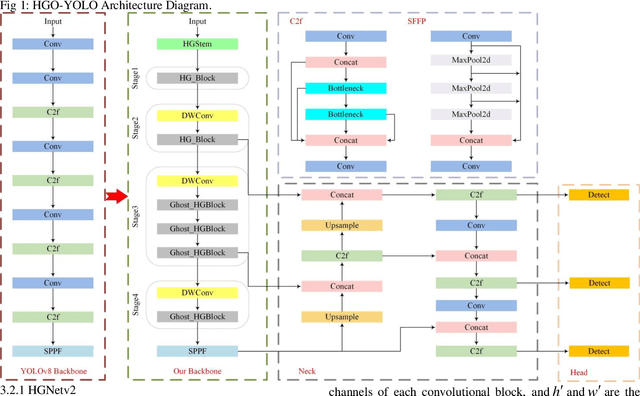
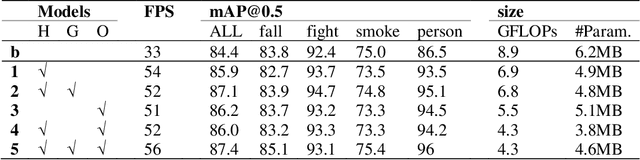
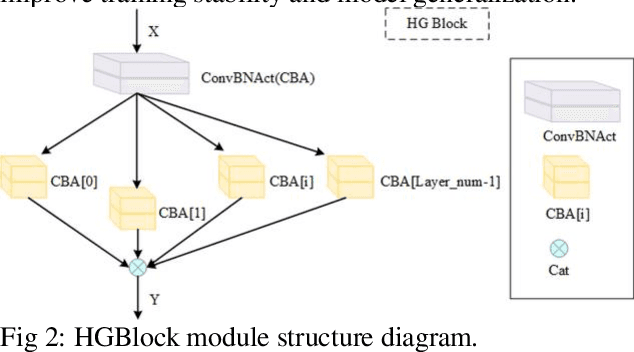
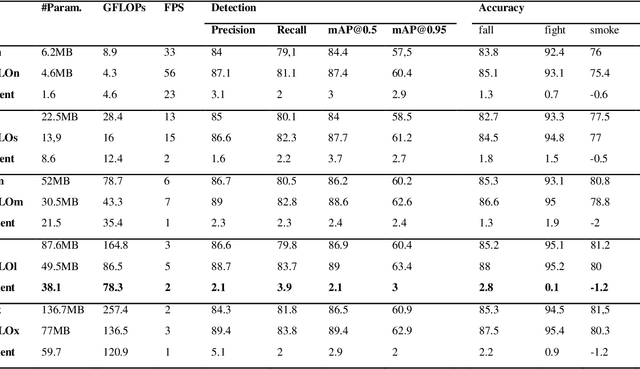
Accurate and real-time object detection is crucial for anomaly behavior detection, especially in scenarios constrained by hardware limitations, where balancing accuracy and speed is essential for enhancing detection performance. This study proposes a model called HGO-YOLO, which integrates the HGNetv2 architecture into YOLOv8. This combination expands the receptive field and captures a wider range of features while simplifying model complexity through GhostConv. We introduced a lightweight detection head, OptiConvDetect, which utilizes parameter sharing to construct the detection head effectively. Evaluation results show that the proposed algorithm achieves a mAP@0.5 of 87.4% and a recall rate of 81.1%, with a model size of only 4.6 MB and a frame rate of 56 FPS on the CPU. HGO-YOLO not only improves accuracy by 3.0% but also reduces computational load by 51.69% (from 8.9 GFLOPs to 4.3 GFLOPs), while increasing the frame rate by a factor of 1.7. Additionally, real-time tests were conducted on Raspberry Pi4 and NVIDIA platforms. These results indicate that the HGO-YOLO model demonstrates superior performance in anomaly behavior detection.