 Add to Chrome
 Add to Firefox
 Add to Edge
Zoom In, Reason Out: Efficient Far-field Anomaly Detection in Expressway Surveillance Videos via Focused VLM Reasoning Guided by Bayesian Inference
Apr 28, 2026
Expressway video anomaly detection is essential for safety management. However, identifying anomalies across diverse scenes remains challenging, particularly for far-field targets exhibiting subtle abnormal vehicle motions. While Vision-Language Models (VLMs) demonstrate strong semantic reasoning capabilities, processing global frames causes attention dilution for these far-field objects and incurs prohibitive computational costs. To address these issues, we propose VIBES, an asynchronous collaborative framework utilizing VLMs guided by Bayesian inference. Specifically, to overcome poor generalization across varying expressway environments, we introduce an online Bayesian inference module. This module continuously evaluates vehicle trajectories to dynamically update the probabilistic boundaries of normal driving behaviors, serving as an asynchronous trigger to precisely localize anomalies in space and time. Instead of processing the continuous video stream, the VLM processes only the localized visual regions indicated by the trigger. This targeted visual input prevents attention dilution and enables accurate semantic reasoning. Extensive evaluations demonstrate that VIBES improves detection accuracy for far-field anomalies and reduces computational overhead, achieving high real-time efficiency and explainability while demonstrating generalization across diverse expressway conditions.

SAMoRA: Semantic-Aware Mixture of LoRA Experts for Task-Adaptive Learning
Apr 21, 2026The combination of Mixture-of-Experts (MoE) and Low-Rank Adaptation (LoRA) has shown significant potential for enhancing the multi-task learning capabilities of Large Language Models. However, existing methods face two primary challenges: (1)Imprecise Routing in the current MoE-LoRA method fails to explicitly match input semantics with expert capabilities, leading to weak expert specialization. (2)Uniform weight fusion strategies struggle to provide adaptive update strengths, overlooking the varying complexity of different tasks. To address these limitations, we propose SAMoRA (Semantic-Aware Mixture of LoRA Experts), a novel parameter-efficient fine-tuning framework tailored for task-adaptive learning. Specifically, A Semantic-Aware Router is proposed to explicitly align textual semantics with the most suitable experts for precise routing. A Task-Adaptive Scaling mechanism is designed to regulate expert contributions based on specific task requirements dynamically. In addition, a novel regularization objective is proposed to jointly promote expert specialization and effective scaling. Extensive experiments on multiple multi-task benchmarks demonstrate that SAMoRA significantly outperforms the state-of-the-art methods and holds excellent task generalization capabilities. Code is available at https://github.com/boyan-code/SAMoRA
STK-Adapter: Incorporating Evolving Graph and Event Chain for Temporal Knowledge Graph Extrapolation
Apr 21, 2026Temporal Knowledge Graph (TKG) extrapolation aims to predict future events based on historical facts. Recent studies have attempted to enhance TKG extrapolation by integrating TKG's evolving structural representations and textual event chains into Large Language Models (LLMs). Yet, two main challenges limit these approaches: (1) The loss of essential spatial-temporal information due to shallow alignment between TKG's graph evolving structural representation and the LLM's semantic space, and (2) the progressive dilution of the TKG's evolving structural features during LLM fine-tuning. To address these challenges, we propose the Spatial-Temporal Knowledge Adapter (STK-Adapter), which flexibly integrates the evolving graph encoder and the LLM to facilitate TKG reasoning. In STK-Adapter, a Spatial-Temporal MoE is designed to capture spatial structures and temporal patterns inherent in TKGs. An Event-Aware MoE is employed to model intricate temporal semantics dependencies within event chains. In addition, a Cross-Modality Alignment MoE is proposed to facilitate deep cross-modality alignment by TKG-guided attention experts. Extensive experiments on benchmark datasets demonstrate that STK-Adapter significantly outperforms state-of-the-art methods and exhibits strong generalization capabilities in cross-dataset task. The code is available at https://github.com/Zhaoshuyuan0246/STK-Adapter.
DiSGMM: A Method for Time-varying Microscopic Weight Completion on Road Networks
Mar 31, 2026Microscopic road-network weights represent fine-grained, time-varying traffic conditions obtained from individual vehicles. An example is travel speeds associated with road segments as vehicles traverse them. These weights support tasks including traffic microsimulation and vehicle routing with reliability guarantees. We study the problem of time-varying microscopic weight completion. During a time slot, the available weights typically cover only some road segments. Weight completion recovers distributions for the weights of every road segment at the current time slot. This problem involves two challenges: (i) contending with two layers of sparsity, where weights are missing at both the network layer (many road segments lack weights) and the segment layer (a segment may have insufficient weights to enable accurate distribution estimation); and (ii) achieving a weight distribution representation that is closed-form and can capture complex conditions flexibly, including heavy tails and multiple clusters. To address these challenges, we propose DiSGMM that combines sparsity-aware embeddings with spatiotemporal modeling to leverage sparse known weights alongside learned segment properties and long-range correlations for distribution estimation. DiSGMM represents distributions of microscopic weights as learnable Gaussian mixture models, providing closed-form distributions capable of capturing complex conditions flexibly. Experiments on two real-world datasets show that DiSGMM can outperform state-of-the-art methods.
Spatial-Temporal Feedback Diffusion Guidance for Controlled Traffic Imputation
Jan 08, 2026Imputing missing values in spatial-temporal traffic data is essential for intelligent transportation systems. Among advanced imputation methods, score-based diffusion models have demonstrated competitive performance. These models generate data by reversing a noising process, using observed values as conditional guidance. However, existing diffusion models typically apply a uniform guidance scale across both spatial and temporal dimensions, which is inadequate for nodes with high missing data rates. Sparse observations provide insufficient conditional guidance, causing the generative process to drift toward the learned prior distribution rather than closely following the conditional observations, resulting in suboptimal imputation performance. To address this, we propose FENCE, a spatial-temporal feedback diffusion guidance method designed to adaptively control guidance scales during imputation. First, FENCE introduces a dynamic feedback mechanism that adjusts the guidance scale based on the posterior likelihood approximations. The guidance scale is increased when generated values diverge from observations and reduced when alignment improves, preventing overcorrection. Second, because alignment to observations varies across nodes and denoising steps, a global guidance scale for all nodes is suboptimal. FENCE computes guidance scales at the cluster level by grouping nodes based on their attention scores, leveraging spatial-temporal correlations to provide more accurate guidance. Experimental results on real-world traffic datasets show that FENCE significantly enhances imputation accuracy.
RIPCN: A Road Impedance Principal Component Network for Probabilistic Traffic Flow Forecasting
Dec 25, 2025Accurate traffic flow forecasting is crucial for intelligent transportation services such as navigation and ride-hailing. In such applications, uncertainty estimation in forecasting is important because it helps evaluate traffic risk levels, assess forecast reliability, and provide timely warnings. As a result, probabilistic traffic flow forecasting (PTFF) has gained significant attention, as it produces both point forecasts and uncertainty estimates. However, existing PTFF approaches still face two key challenges: (1) how to uncover and model the causes of traffic flow uncertainty for reliable forecasting, and (2) how to capture the spatiotemporal correlations of uncertainty for accurate prediction. To address these challenges, we propose RIPCN, a Road Impedance Principal Component Network that integrates domain-specific transportation theory with spatiotemporal principal component learning for PTFF. RIPCN introduces a dynamic impedance evolution network that captures directional traffic transfer patterns driven by road congestion level and flow variability, revealing the direct causes of uncertainty and enhancing both reliability and interpretability. In addition, a principal component network is designed to forecast the dominant eigenvectors of future flow covariance, enabling the model to capture spatiotemporal uncertainty correlations. This design allows for accurate and efficient uncertainty estimation while also improving point prediction performance. Experimental results on real-world datasets show that our approach outperforms existing probabilistic forecasting methods.
TransferTraj: A Vehicle Trajectory Learning Model for Region and Task Transferability
May 19, 2025Vehicle GPS trajectories provide valuable movement information that supports various downstream tasks and applications. A desirable trajectory learning model should be able to transfer across regions and tasks without retraining, avoiding the need to maintain multiple specialized models and subpar performance with limited training data. However, each region has its unique spatial features and contexts, which are reflected in vehicle movement patterns and difficult to generalize. Additionally, transferring across different tasks faces technical challenges due to the varying input-output structures required for each task. Existing efforts towards transferability primarily involve learning embedding vectors for trajectories, which perform poorly in region transfer and require retraining of prediction modules for task transfer. To address these challenges, we propose TransferTraj, a vehicle GPS trajectory learning model that excels in both region and task transferability. For region transferability, we introduce RTTE as the main learnable module within TransferTraj. It integrates spatial, temporal, POI, and road network modalities of trajectories to effectively manage variations in spatial context distribution across regions. It also introduces a TRIE module for incorporating relative information of spatial features and a spatial context MoE module for handling movement patterns in diverse contexts. For task transferability, we propose a task-transferable input-output scheme that unifies the input-output structure of different tasks into the masking and recovery of modalities and trajectory points. This approach allows TransferTraj to be pre-trained once and transferred to different tasks without retraining. Extensive experiments on three real-world vehicle trajectory datasets under task transfer, zero-shot, and few-shot region transfer, validating TransferTraj's effectiveness.
Towards An Efficient and Effective En Route Travel Time Estimation Framework
Apr 05, 2025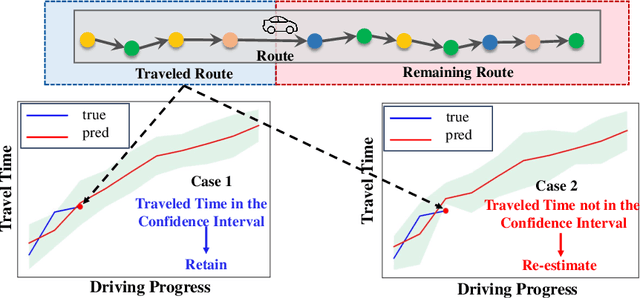
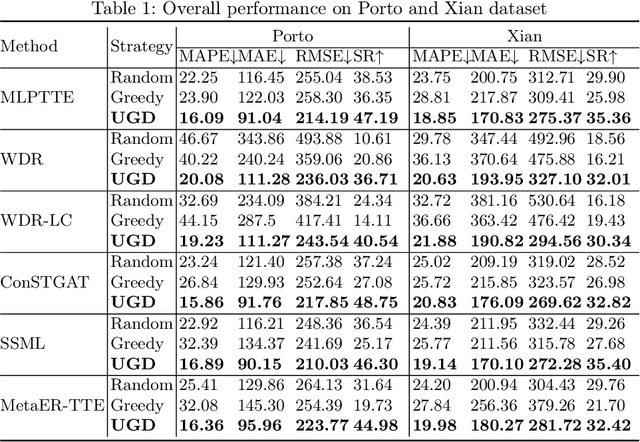
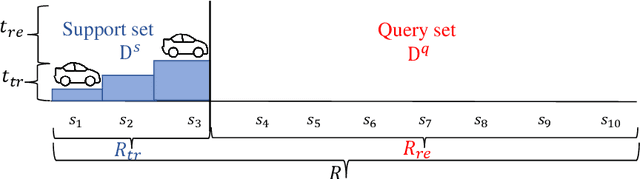
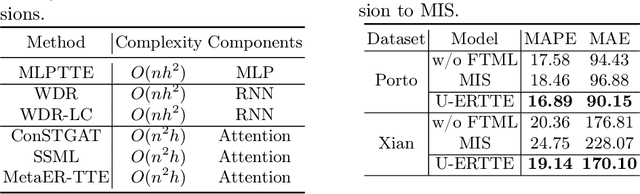
En route travel time estimation (ER-TTE) focuses on predicting the travel time of the remaining route. Existing ER-TTE methods always make re-estimation which significantly hinders real-time performance, especially when faced with the computational demands of simultaneous user requests. This results in delays and reduced responsiveness in ER-TTE services. We propose a general efficient framework U-ERTTE combining an Uncertainty-Guided Decision mechanism (UGD) and Fine-Tuning with Meta-Learning (FTML) to address these challenges. UGD quantifies the uncertainty and provides confidence intervals for the entire route. It selectively re-estimates only when the actual travel time deviates from the predicted confidence intervals, thereby optimizing the efficiency of ER-TTE. To ensure the accuracy of confidence intervals and accurate predictions that need to re-estimate, FTML is employed to train the model, enabling it to learn general driving patterns and specific features to adapt to specific tasks. Extensive experiments on two large-scale real datasets demonstrate that the U-ERTTE framework significantly enhances inference speed and throughput while maintaining high effectiveness. Our code is available at https://github.com/shenzekai/U-ERTTE
An Experimental Evaluation of Imputation Models for Spatial-Temporal Traffic Data
Dec 06, 2024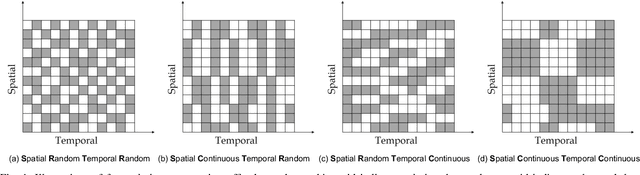
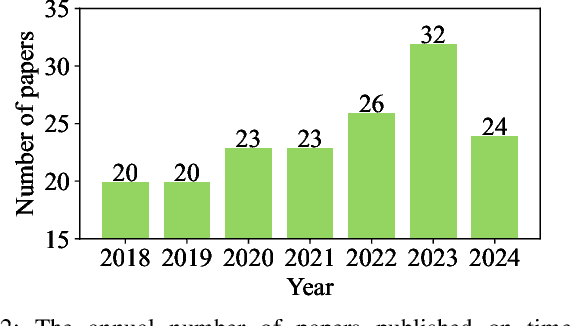
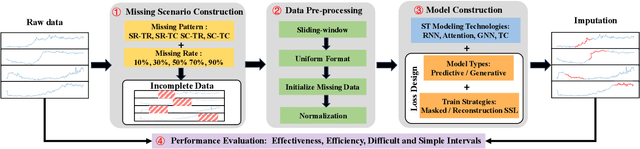
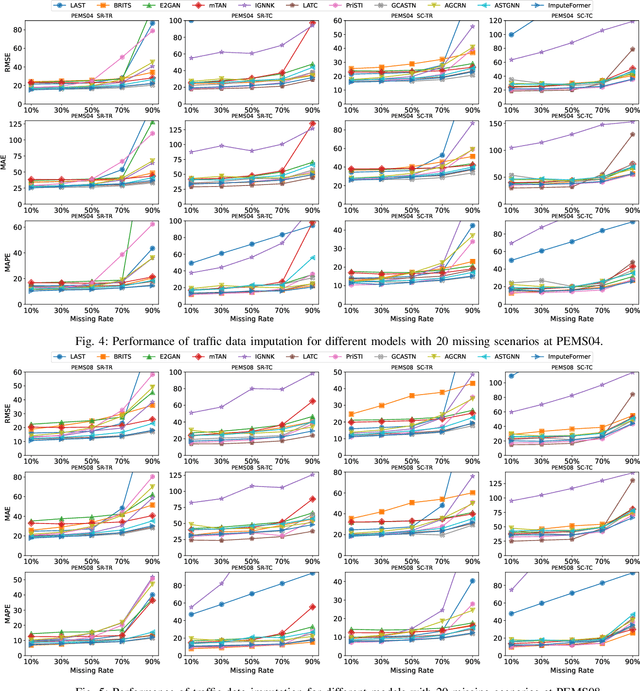
Traffic data imputation is a critical preprocessing step in intelligent transportation systems, enabling advanced transportation services. Despite significant advancements in this field, selecting the most suitable model for practical applications remains challenging due to three key issues: 1) incomprehensive consideration of missing patterns that describe how data loss along spatial and temporal dimensions, 2) the lack of test on standardized datasets, and 3) insufficient evaluations. To this end, we first propose practice-oriented taxonomies for missing patterns and imputation models, systematically identifying all possible forms of real-world traffic data loss and analyzing the characteristics of existing models. Furthermore, we introduce a unified benchmarking pipeline to comprehensively evaluate 10 representative models across various missing patterns and rates. This work aims to provide a holistic understanding of traffic data imputation research and serve as a practical guideline.
DiffLight: A Partial Rewards Conditioned Diffusion Model for Traffic Signal Control with Missing Data
Oct 31, 2024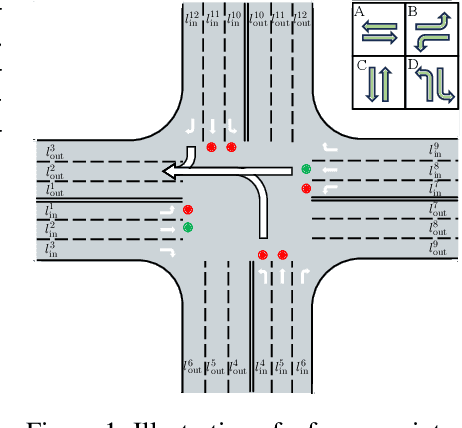


The application of reinforcement learning in traffic signal control (TSC) has been extensively researched and yielded notable achievements. However, most existing works for TSC assume that traffic data from all surrounding intersections is fully and continuously available through sensors. In real-world applications, this assumption often fails due to sensor malfunctions or data loss, making TSC with missing data a critical challenge. To meet the needs of practical applications, we introduce DiffLight, a novel conditional diffusion model for TSC under data-missing scenarios in the offline setting. Specifically, we integrate two essential sub-tasks, i.e., traffic data imputation and decision-making, by leveraging a Partial Rewards Conditioned Diffusion (PRCD) model to prevent missing rewards from interfering with the learning process. Meanwhile, to effectively capture the spatial-temporal dependencies among intersections, we design a Spatial-Temporal transFormer (STFormer) architecture. In addition, we propose a Diffusion Communication Mechanism (DCM) to promote better communication and control performance under data-missing scenarios. Extensive experiments on five datasets with various data-missing scenarios demonstrate that DiffLight is an effective controller to address TSC with missing data. The code of DiffLight is released at https://github.com/lokol5579/DiffLight-release.