 Add to Chrome
 Add to Firefox
 Add to Edge
From Local Indices to Global Identifiers: Generative Reranking for Recommender Systems via Global Action Space
Apr 28, 2026
In modern recommender systems, list-wise reranking serves as a critical phase within the multi-stage pipeline, finalizing the exposed item sequence and directly impacting user satisfaction by modeling complex intra-list item dependencies. Existing methods typically formulate this task as selecting indices from the local input list. However, this approach suffers from a semantically inconsistent action space: the same output neuron (logits) represents different items across different samples, preventing the model from establishing a stable, intrinsic understanding of the items. To address this, we propose GloRank (Global Action Space Ranker), a generative framework that shifts reranking from selecting local indices to generating global identifiers. Specifically, we represent items as sequences of discrete tokens and reformulate reranking as a token generation task. This design effectively decouples the scoring mechanism from the variable input order, ensuring that items are evaluated against a consistent global standard. We further enhance this with a two-stage optimization pipeline: a supervised pre-training phase to initialize the model with high-quality demonstrations, followed by a reinforcement learning-based post-training phase to directly maximize list-wise utility. Extensive experiments on two public benchmarks and a large-scale industrial dataset, coupled with online A/B tests, demonstrate that GloRank consistently outperforms state-of-the-art baselines and achieves superior robustness in cold-start scenarios.

MultiDx: A Multi-Source Knowledge Integration Framework towards Diagnostic Reasoning
Apr 27, 2026Diagnostic prediction and clinical reasoning are critical tasks in healthcare applications. While Large Language Models (LLMs) have shown strong capabilities in commonsense reasoning, they still struggle with diagnostic reasoning due to limited domain knowledge. Existing approaches often rely on internal model knowledge or static knowledge bases, resulting in knowledge insufficiency and limited adaptability, which hinder their capacity to perform diagnostic reasoning. Moreover, these methods focus solely on the accuracy of final predictions, overlooking alignment with standard clinical reasoning trajectories. To this end, we propose MultiDx, a two-stage diagnostic reasoning framework that performs differential diagnosis by analyzing evidence collected from multiple knowledge sources. Specifically, it first generates suspected diagnoses and reasoning paths by leveraging knowledge from web search, SOAP-formatted case, and clinical case database. Then it integrates multi-perspective evidence through matching, voting, and differential diagnosis to generate the final prediction.~Extensive experiments on two public benchmarks demonstrate the effectiveness of our approach.
GeoRouter: Dynamic Paradigm Routing for Worldwide Image Geolocalization
Mar 25, 2026Worldwide image geolocalization aims to predict precise GPS coordinates for images captured anywhere on Earth, which is challenging due to the large visual and geographic diversity. Recent methods mainly follow two paradigms: retrieval-based approaches that match queries against a reference database, and generation-based approaches that directly predict coordinates using Large Vision-Language Models (LVLMs). However, we observe distinct error profiles between them: retrieval excels at fine-grained instance matching, while generation offers robust semantic reasoning. This complementary heterogeneity suggests that no single paradigm is universally superior. To harness this potential, we propose GeoRouter, a dynamic routing framework that adaptively assigns each query to the optimal paradigm. GeoRouter leverages an LVLM backbone to analyze visual content and provide routing decisions. To optimize GeoRouter, we introduce a distance-aware preference objective that converts the distance gap between paradigms into a continuous supervision signal, explicitly reflecting relative performance differences. Furthermore, we construct GeoRouting, the first large-scale dataset tailored for training routing policies with independent paradigm predictions. Extensive experiments on IM2GPS3k and YFCC4k demonstrate that GeoRouter significantly outperforms state-of-the-art baselines.
How to Utilize Complementary Vision-Text Information for 2D Structure Understanding
Mar 17, 2026LLMs typically linearize 2D tables into 1D sequences to fit their autoregressive architecture, which weakens row-column adjacency and other layout cues. In contrast, purely visual encoders can capture spatial cues, yet often struggle to preserve exact cell text. Our analysis reveals that these two modalities provide highly distinct information to LLMs and exhibit strong complementarity. However, direct concatenation and other fusion methods yield limited gains and frequently introduce cross-modal interference. To address this issue, we propose DiVA-Former, a lightweight architecture designed to effectively integrate vision and text information. DiVA-Former leverages visual tokens as dynamic queries to distill long textual sequences into digest vectors, thereby effectively exploiting complementary vision--text information. Evaluated across 13 table benchmarks, DiVA-Former improves upon the pure-text baseline by 23.9\% and achieves consistent gains over existing baselines using visual inputs, textual inputs, or a combination of both.
Enhancing Cross-View UAV Geolocalization via LVLM-Driven Relational Modeling
Mar 09, 2026The primary objective of cross-view UAV geolocalization is to identify the exact spatial coordinates of drone-captured imagery by aligning it with extensive, geo-referenced satellite databases. Current approaches typically extract features independently from each perspective and rely on basic heuristics to compute similarity, thereby failing to explicitly capture the essential interactions between different views. To address this limitation, we introduce a novel, plug-and-play ranking architecture designed to explicitly perform joint relational modeling for improved UAV-to-satellite image matching. By harnessing the capabilities of a Large Vision-Language Model (LVLM), our framework effectively learns the deep visual-semantic correlations linking UAV and satellite imagery. Furthermore, we present a novel relational-aware loss function to optimize the training phase. By employing soft labels, this loss provides fine-grained supervision that avoids overly penalizing near-positive matches, ultimately boosting both the model's discriminative power and training stability. Comprehensive evaluations across various baseline architectures and standard benchmarks reveal that the proposed method substantially boosts the retrieval accuracy of existing models, yielding superior performance even under highly demanding conditions.
To Search or Not to Search: Aligning the Decision Boundary of Deep Search Agents via Causal Intervention
Feb 03, 2026Deep search agents, which autonomously iterate through multi-turn web-based reasoning, represent a promising paradigm for complex information-seeking tasks. However, current agents suffer from critical inefficiency: they conduct excessive searches as they cannot accurately judge when to stop searching and start answering. This stems from outcome-centric training that prioritize final results over the search process itself. We identify the root cause as misaligned decision boundaries, the threshold determining when accumulated information suffices to answer. This causes over-search (redundant searching despite sufficient knowledge) and under-search (premature termination yielding incorrect answers). To address these errors, we propose a comprehensive framework comprising two key components. First, we introduce causal intervention-based diagnosis that identifies boundary errors by comparing factual and counterfactual trajectories at each decision point. Second, we develop Decision Boundary Alignment for Deep Search agents (DAS), which constructs preference datasets from causal feedback and aligns policies via preference optimization. Experiments on public datasets demonstrate that decision boundary errors are pervasive across state-of-the-art agents. Our DAS method effectively calibrates these boundaries, mitigating both over-search and under-search to achieve substantial gains in accuracy and efficiency. Our code and data are publicly available at: https://github.com/Applied-Machine-Learning-Lab/WWW2026_DAS.
Exploring Recommender System Evaluation: A Multi-Modal User Agent Framework for A/B Testing
Jan 08, 2026In recommender systems, online A/B testing is a crucial method for evaluating the performance of different models. However, conducting online A/B testing often presents significant challenges, including substantial economic costs, user experience degradation, and considerable time requirements. With the Large Language Models' powerful capacity, LLM-based agent shows great potential to replace traditional online A/B testing. Nonetheless, current agents fail to simulate the perception process and interaction patterns, due to the lack of real environments and visual perception capability. To address these challenges, we introduce a multi-modal user agent for A/B testing (A/B Agent). Specifically, we construct a recommendation sandbox environment for A/B testing, enabling multimodal and multi-page interactions that align with real user behavior on online platforms. The designed agent leverages multimodal information perception, fine-grained user preferences, and integrates profiles, action memory retrieval, and a fatigue system to simulate complex human decision-making. We validated the potential of the agent as an alternative to traditional A/B testing from three perspectives: model, data, and features. Furthermore, we found that the data generated by A/B Agent can effectively enhance the capabilities of recommendation models. Our code is publicly available at https://github.com/Applied-Machine-Learning-Lab/ABAgent.
Renormalization Group Guided Tensor Network Structure Search
Dec 31, 2025Tensor network structure search (TN-SS) aims to automatically discover optimal network topologies and rank configurations for efficient tensor decomposition in high-dimensional data representation. Despite recent advances, existing TN-SS methods face significant limitations in computational tractability, structure adaptivity, and optimization robustness across diverse tensor characteristics. They struggle with three key challenges: single-scale optimization missing multi-scale structures, discrete search spaces hindering smooth structure evolution, and separated structure-parameter optimization causing computational inefficiency. We propose RGTN (Renormalization Group guided Tensor Network search), a physics-inspired framework transforming TN-SS via multi-scale renormalization group flows. Unlike fixed-scale discrete search methods, RGTN uses dynamic scale-transformation for continuous structure evolution across resolutions. Its core innovation includes learnable edge gates for optimization-stage topology modification and intelligent proposals based on physical quantities like node tension measuring local stress and edge information flow quantifying connectivity importance. Starting from low-complexity coarse scales and refining to finer ones, RGTN finds compact structures while escaping local minima via scale-induced perturbations. Extensive experiments on light field data, high-order synthetic tensors, and video completion tasks show RGTN achieves state-of-the-art compression ratios and runs 4-600$\times$ faster than existing methods, validating the effectiveness of our physics-inspired approach.
BlossomRec: Block-level Fused Sparse Attention Mechanism for Sequential Recommendations
Dec 15, 2025Transformer structures have been widely used in sequential recommender systems (SRS). However, as user interaction histories increase, computational time and memory requirements also grow. This is mainly caused by the standard attention mechanism. Although there exist many methods employing efficient attention and SSM-based models, these approaches struggle to effectively model long sequences and may exhibit unstable performance on short sequences. To address these challenges, we design a sparse attention mechanism, BlossomRec, which models both long-term and short-term user interests through attention computation to achieve stable performance across sequences of varying lengths. Specifically, we categorize user interests in recommendation systems into long-term and short-term interests, and compute them using two distinct sparse attention patterns, with the results combined through a learnable gated output. Theoretically, it significantly reduces the number of interactions participating in attention computation. Extensive experiments on four public datasets demonstrate that BlossomRec, when integrated with state-of-the-art Transformer-based models, achieves comparable or even superior performance while significantly reducing memory usage, providing strong evidence of BlossomRec's efficiency and effectiveness.The code is available at https://github.com/ronineume/BlossomRec.
GeoArena: An Open Platform for Benchmarking Large Vision-language Models on WorldWide Image Geolocalization
Sep 04, 2025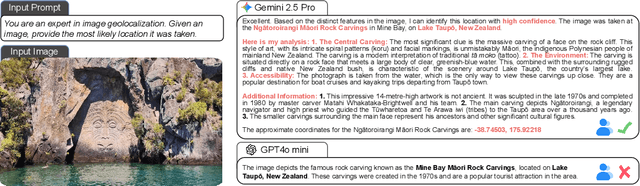

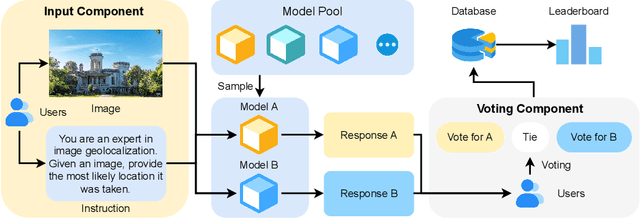
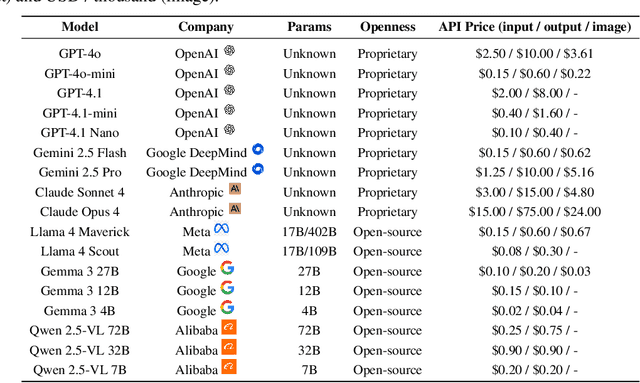
Image geolocalization aims to predict the geographic location of images captured anywhere on Earth, but its global nature presents significant challenges. Current evaluation methodologies suffer from two major limitations. First, data leakage: advanced approaches often rely on large vision-language models (LVLMs) to predict image locations, yet these models are frequently pretrained on the test datasets, compromising the accuracy of evaluating a model's actual geolocalization capability. Second, existing metrics primarily rely on exact geographic coordinates to assess predictions, which not only neglects the reasoning process but also raises privacy concerns when user-level location data is required. To address these issues, we propose GeoArena, a first open platform for evaluating LVLMs on worldwide image geolocalization tasks, offering true in-the-wild and human-centered benchmarking. GeoArena enables users to upload in-the-wild images for a more diverse evaluation corpus, and it leverages pairwise human judgments to determine which model output better aligns with human expectations. Our platform has been deployed online for two months, during which we collected over thousands voting records. Based on this data, we conduct a detailed analysis and establish a leaderboard of different LVLMs on the image geolocalization task.