 Add to Chrome
 Add to Firefox
 Add to Edge
Revisiting the Travel Planning Capabilities of Large Language Models
May 05, 2026
Travel planning serves as a critical task for long-horizon reasoning, exposing significant deficits in LLMs. However, existing benchmarks and evaluations primarily assess final plans in an end-to-end manner, which lacks interpretability and makes it difficult to analyze the root causes of failures. To bridge this gap, we decompose travel planning into five constituent atomic sub-capabilities, including \emph{Constraint Extraction}, \emph{Tool Use}, \emph{Plan Generation}, \emph{Error Identification}, and \emph{Error Correction}. We implement a decoupled evaluation protocol leveraging oracle intermediate contexts to rigorously isolate these components, thereby measuring the atomic performance boundary without the noise of cascading errors. Our results highlight a clear contrast in performance: while LLMs are proficient in extracting explicit constraints, they struggle to infer implicit, open-world requirements. Furthermore, they exhibit structural biases in plan generation and suffer from ineffective self-correction, characterized by excessive sensitivity and erroneous persistence. These findings offer precise directions for improving LLM reasoning and planning abilities.

Programmatic Context Augmentation for LLM-based Symbolic Regression
May 04, 2026Symbolic regression (SR), the task of discovering mathematical expressions that best describe a given dataset, remains a fundamental challenge in scientific discovery. Traditional approaches, primarily based on genetic algorithms and related evolutionary methods, have proven useful but suffer from scalability and expressivity limitations. Recently, large language model (LLM)-based evolutionary search methods have been introduced into SR and show promise. However, existing LLM-based approaches typically rely on scalar evaluation metrics, such as mean squared error, as the sole source of feedback during the search process, thereby overlooking the rich information embedded in the dataset. To address this limitation, we propose a novel LLM-based evolutionary search framework that incorporates programmatic context augmentation. By enabling code-based interactions with the dataset, our method can actively perform data analysis and extract informative signals, beyond aggregated evaluation scores. We evaluate our framework on advanced benchmarks, such as LLM-SRBench, and demonstrate superior efficiency and accuracy compared to strong baselines.
Aligning Agents via Planning: A Benchmark for Trajectory-Level Reward Modeling
Apr 09, 2026In classical Reinforcement Learning from Human Feedback (RLHF), Reward Models (RMs) serve as the fundamental signal provider for model alignment. As Large Language Models evolve into agentic systems capable of autonomous tool invocation and complex reasoning, the paradigm of reward modeling faces unprecedented challenges--most notably, the lack of benchmarks specifically designed to assess RM capabilities within tool-integrated environments. To address this gap, we present Plan-RewardBench, a trajectory-level preference benchmark designed to evaluate how well judges distinguish preferred versus distractor agent trajectories in complex tool-using scenarios. Plan-RewardBench covers four representative task families -- (i) Safety Refusal, (ii) Tool-Irrelevance / Unavailability, (iii) Complex Planning, and (iv) Robust Error Recovery -- comprising validated positive trajectories and confusable hard negatives constructed via multi-model natural rollouts, rule-based perturbations, and minimal-edit LLM perturbations. We benchmark representative RMs (generative, discriminative, and LLM-as-Judge) under a unified pairwise protocol, reporting accuracy trends across varying trajectory lengths and task categories. Furthermore, we provide diagnostic analyses of prevalent failure modes. Our results reveal that all three evaluator families face substantial challenges, with performance degrading sharply on long-horizon trajectories, underscoring the necessity for specialized training in agentic, trajectory-level reward modeling. Ultimately, Plan-RewardBench aims to serve as both a practical evaluation suite and a reusable blueprint for constructing agentic planning preference data.
LAST: Leveraging Tools as Hints to Enhance Spatial Reasoning for Multimodal Large Language Models
Apr 08, 2026Spatial reasoning is a cornerstone capability for intelligent systems to perceive and interact with the physical world. However, multimodal large language models (MLLMs) frequently suffer from hallucinations and imprecision when parsing complex geometric layouts. As data-driven scaling struggles to internalize structured geometric priors and spatial constraints, integrating mature, specialized vision models presents a compelling alternative. Despite its promise, applying this paradigm to spatial reasoning is hindered by two key challenges: The difficulty of invoking heterogeneous, parameter-rich tools, as well as the challenge of understanding and effectively leveraging their diverse low-level outputs (e.g., segmentation masks, depth maps) in high-level reasoning. To address these challenges, we propose LAST, a unified framework for tool-augmented spatial reasoning. LAST features an extensible interactive sandbox, termed LAST-Box, which abstracts heterogeneous tool invocations into atomic instructions and reusable spatial skills, returning multimodal hints (e.g., annotated images and textual descriptions) that can be directly consumed by LLMs. We further design a three-stage progressive training strategy that guides models from understanding tool outputs to proficient and adaptive tool invocation. Experiments on four datasets show that LAST-7B achieves around 20\% performance gains over its backbone and outperforms strong proprietary closed-source LLMs, substantially enhancing reasoning on complex spatial tasks.
Aligning Progress and Feasibility: A Neuro-Symbolic Dual Memory Framework for Long-Horizon LLM Agents
Apr 03, 2026Large language models (LLMs) have demonstrated strong potential in long-horizon decision-making tasks, such as embodied manipulation and web interaction. However, agents frequently struggle with endless trial-and-error loops or deviate from the main objective in complex environments. We attribute these failures to two fundamental errors: global Progress Drift and local Feasibility Violation. Existing methods typically attempt to address both issues simultaneously using a single paradigm. However, these two challenges are fundamentally distinct: the former relies on fuzzy semantic planning, while the latter demands strict logical constraints and state validation. The inherent limitations of such a single-paradigm approach pose a fundamental challenge for existing models in handling long-horizon tasks. Motivated by this insight, we propose a Neuro-Symbolic Dual Memory Framework that explicitly decouples semantic progress guidance from logical feasibility verification. Specifically, during the inference phase, the framework invokes both memory mechanisms synchronously: on one hand, a neural-network-based Progress Memory extracts semantic blueprints from successful trajectories to guide global task advancement; on the other hand, a symbolic-logic-based Feasibility Memory utilizes executable Python verification functions synthesized from failed transitions to perform strict logical validation. Experiments demonstrate that this method significantly outperforms existing competitive baselines on ALFWorld, WebShop, and TextCraft, while drastically reducing the invalid action rate and average trajectory length.
Thinking with Tables: Enhancing Multi-Modal Tabular Understanding via Neuro-Symbolic Reasoning
Mar 25, 2026Multimodal Large Language Models (MLLMs) have demonstrated remarkable reasoning capabilities across modalities such as images and text. However, tabular data, despite being a critical real-world modality, remains relatively underexplored in multimodal learning. In this paper, we focus on the task of Tabular-Vision Multi-Modal Understanding (TVMU) and identify three core challenges: (1) high structural variability and data incompleteness in tables, (2) implicit and complex feature dependencies, and (3) significant heterogeneity in problem-solving pipelines across downstream tasks. To address these issues, we propose Thinking with Tables (TWT). TWT employs a program-aided code-based neuro-symbolic reasoning mechanism that facilitates key operations, such as information extraction and element modeling, by interacting with external environments. We evaluate TWT on eight representative datasets. Experimental results demonstrate that TWT consistently outperforms existing baselines by an average of 10\% in accuracy, achieving performance comparable to, or even surpassing, proprietary commercial SOTA LLMs on TVMU tasks. Models and codes are available at https://github.com/kunyang-YU/Thinking-with-Tables
A Progressive Visual-Logic-Aligned Framework for Ride-Hailing Adjudication
Mar 18, 2026The efficient adjudication of responsibility disputes is pivotal for maintaining marketplace fairness. However, the exponential surge in ride-hailing volume renders manual review intractable, while conventional automated methods lack the reasoning transparency required for quasi-judicial decisions. Although Multimodal LLMs offer a promising paradigm, they fundamentally struggle to bridge the gap between general visual semantics and rigorous evidentiary protocols, often leading to perceptual hallucinations and logical looseness. To address these systemic misalignments, we introduce RideJudge, a Progressive Visual-Logic-Aligned Framework. Instead of relying on generic pre-training, we bridge the semantic gap via SynTraj, a synthesis engine that grounds abstract liability concepts into concrete trajectory patterns. To resolve the conflict between massive regulation volume and limited context windows, we propose an Adaptive Context Optimization strategy that distills expert knowledge, coupled with a Chain-of-Adjudication mechanism to enforce active evidentiary inquiry. Furthermore, addressing the inadequacy of sparse binary feedback for complex liability assessment, we implement a novel Ordinal-Sensitive Reinforcement Learning mechanism that calibrates decision boundaries against hierarchical severity. Extensive experiments show that our RideJudge-8B achieves 88.41\% accuracy, surpassing 32B-scale baselines and establishing a new standard for interpretable adjudication.
NeSy-Route: A Neuro-Symbolic Benchmark for Constrained Route Planning in Remote Sensing
Mar 17, 2026Remote sensing underpins crucial applications such as disaster relief and ecological field surveys, where systems must understand complex scenes and constraints and make reliable decisions. Current remote-sensing benchmarks mainly focus on evaluating perception and reasoning capabilities of multimodal large language models (MLLMs). They fail to assess planning capability, stemming either from the difficulty of curating and validating planning tasks at scale or from evaluation protocols that are inaccurate and inadequate. To address these limitations, we introduce NeSy-Route, a large-scale neuro-symbolic benchmark for constrained route planning in remote sensing. Within this benchmark, we introduce an automated data-generation framework that integrates high-fidelity semantic masks with heuristic search to produce diverse route-planning tasks with provably optimal solutions. This allows NeSy-Route to comprehensively evaluate planning across 10,821 route-planning samples, nearly 10 times larger than the largest prior benchmark. Furthermore, a three-level hierarchical neuro-symbolic evaluation protocol is developed to enable accurate assessment and support fine-grained analysis on perception, reasoning, and planning simultaneously. Our comprehensive evaluation of various state-of-the-art MLLMs demonstrates that existing MLLMs show significant deficiencies in perception and planning capabilities. We hope NeSy-Route can support further research and development of more powerful MLLMs for remote sensing.
Bi-CoG: Bi-Consistency-Guided Self-Training for Vision-Language Models
Oct 23, 2025Exploiting unlabeled data through semi-supervised learning (SSL) or leveraging pre-trained models via fine-tuning are two prevailing paradigms for addressing label-scarce scenarios. Recently, growing attention has been given to combining fine-tuning of pre-trained vision-language models (VLMs) with SSL, forming the emerging paradigm of semi-supervised fine-tuning. However, existing methods often suffer from model bias and hyperparameter sensitivity, due to reliance on prediction consistency or pre-defined confidence thresholds. To address these limitations, we propose a simple yet effective plug-and-play methodology named $\underline{\textbf{Bi-Co}}$nsistency-$\underline{\textbf{G}}$uided Self-Training (Bi-CoG), which assigns high-quality and low-bias pseudo-labels, by simultaneously exploiting inter-model and intra-model consistency, along with an error-aware dynamic pseudo-label assignment strategy. Both theoretical analysis and extensive experiments over 14 datasets demonstrate the effectiveness of Bi-CoG, which consistently and significantly improves the performance of existing methods.
Beyond Single: A Data Selection Principle for LLM Alignment via Fine-Grained Preference Signals
Aug 11, 2025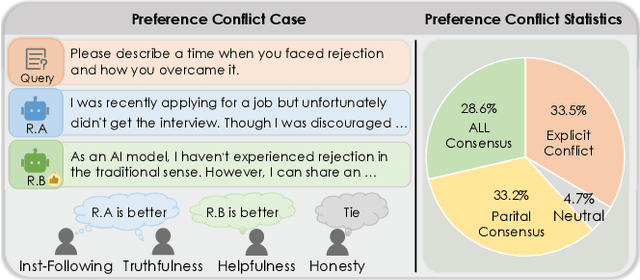
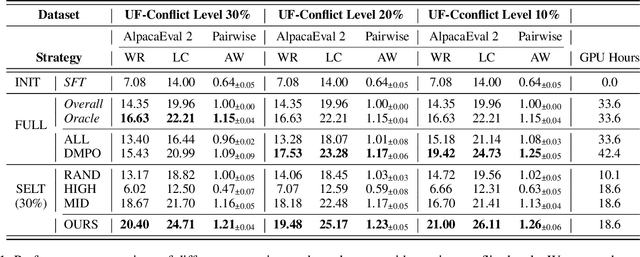
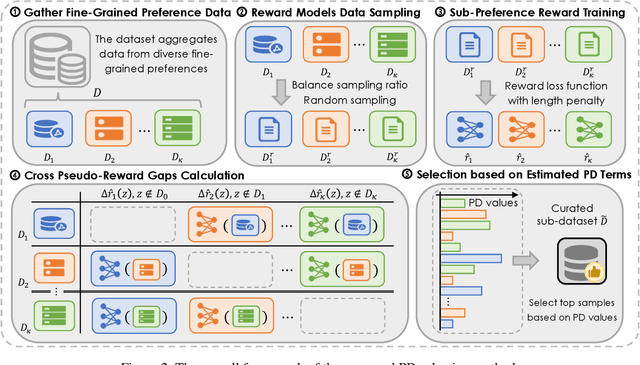
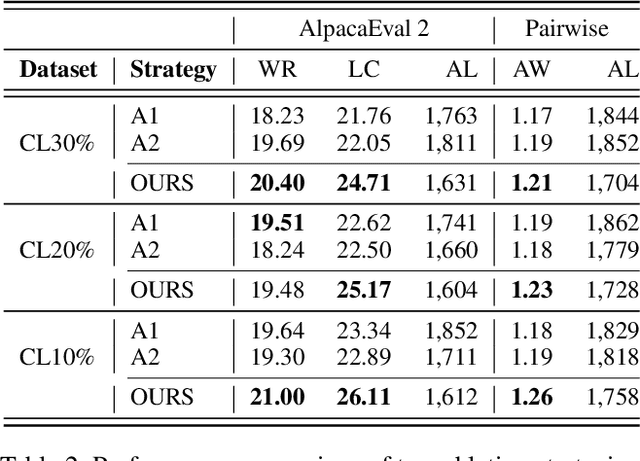
Aligning Large Language Models (LLMs) with diverse human values requires moving beyond a single holistic "better-than" preference criterion. While collecting fine-grained, aspect-specific preference data is more reliable and scalable, existing methods like Direct Preference Optimization (DPO) struggle with the severe noise and conflicts inherent in such aggregated datasets. In this paper, we tackle this challenge from a data-centric perspective. We first derive the Direct Multi-Preference Optimization (DMPO) objective, and uncover a key Preference Divergence (PD) term that quantifies inter-aspect preference conflicts. Instead of using this term for direct optimization, we leverage it to formulate a novel, theoretically-grounded data selection principle. Our principle advocates for selecting a subset of high-consensus data-identified by the most negative PD values-for efficient DPO training. We prove the optimality of this strategy by analyzing the loss bounds of the DMPO objective in the selection problem. To operationalize our approach, we introduce practical methods of PD term estimation and length bias mitigation, thereby proposing our PD selection method. Evaluation on the UltraFeedback dataset with three varying conflict levels shows that our simple yet effective strategy achieves over 10% relative improvement against both the standard holistic preference and a stronger oracle using aggregated preference signals, all while boosting training efficiency and obviating the need for intractable holistic preference annotating, unlocking the potential of robust LLM alignment via fine-grained preference signals.