 Add to Chrome
 Add to Firefox
 Add to Edge
Multi-view Crowd Tracking Transformer with View-Ground Interactions Under Large Real-World Scenes
Apr 21, 2026
Multi-view crowd tracking estimates each person's tracking trajectories on the ground of the scene. Recent research works mainly rely on CNNs-based multi-view crowd tracking architectures, and most of them are evaluated and compared on relatively small datasets, such as Wildtrack and MultiviewX. Since these two datasets are collected in small scenes and only contain tens of frames in the evaluation stage, it is difficult for the current methods to be applied to real-world applications where scene size and occlusion are more complicated. In this paper, we propose a Transformer-based multi-view crowd tracking model, \textit{MVTrackTrans}, which adopts interactions between camera views and the ground plane for enhanced multi-view tracking performance. Besides, for better evaluation, we collect and label two large real-world multi-view tracking datasets, MVCrowdTrack and CityTrack, which contain a much larger scene size over a longer time period. Compared with existing methods on the two large and new datasets, the proposed MVTrackTrans model achieves better performance, demonstrating the advantages of the model design in dealing with large scenes. We believe the proposed datasets and model will push the frontiers of the task to more practical scenarios, and the datasets and code are available at: https://github.com/zqyq/MVTrackTrans.

CocoaBench: Evaluating Unified Digital Agents in the Wild
Apr 14, 2026LLM agents now perform strongly in software engineering, deep research, GUI automation, and various other applications, while recent agent scaffolds and models are increasingly integrating these capabilities into unified systems. Yet, most evaluations still test these capabilities in isolation, which leaves a gap for more diverse use cases that require agents to combine different capabilities. We introduce CocoaBench, a benchmark for unified digital agents built from human-designed, long-horizon tasks that require flexible composition of vision, search, and coding. Tasks are specified only by an instruction and an automatic evaluation function over the final output, enabling reliable and scalable evaluation across diverse agent infrastructures. We also present CocoaAgent, a lightweight shared scaffold for controlled comparison across model backbones. Experiments show that current agents remain far from reliable on CocoaBench, with the best evaluated system achieving only 45.1% success rate. Our analysis further points to substantial room for improvement in reasoning and planning, tool use and execution, and visual grounding.
DeliveryBench: Can Agents Earn Profit in Real World?
Dec 22, 2025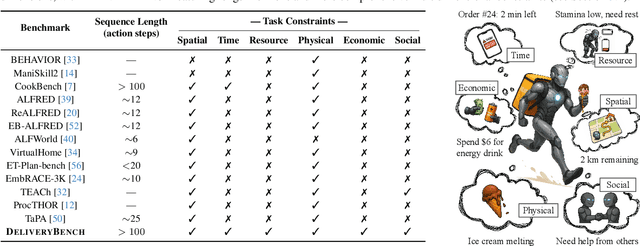
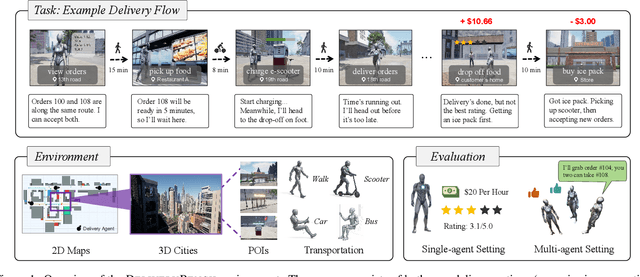
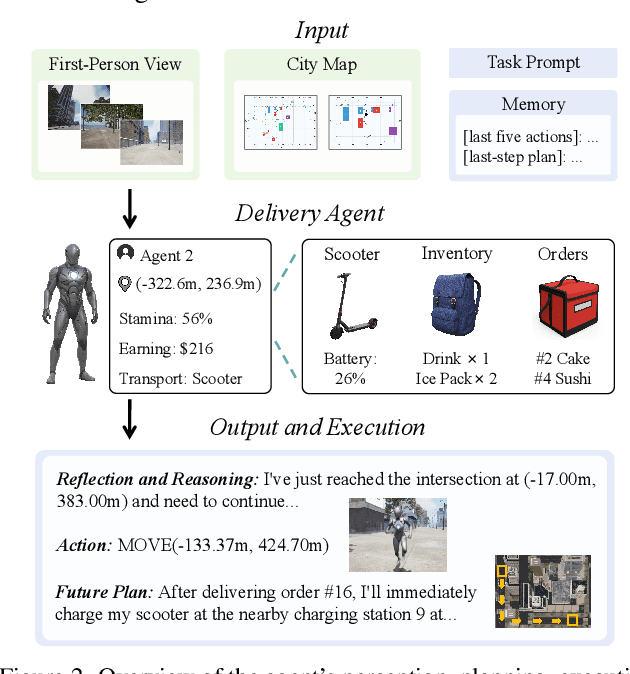
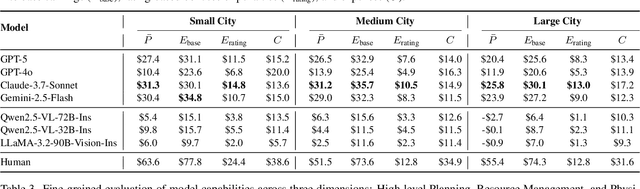
LLMs and VLMs are increasingly deployed as embodied agents, yet existing benchmarks largely revolve around simple short-term tasks and struggle to capture rich realistic constraints that shape real-world decision making. To close this gap, we propose DeliveryBench, a city-scale embodied benchmark grounded in the real-world profession of food delivery. Food couriers naturally operate under long-horizon objectives (maximizing net profit over hours) while managing diverse constraints, e.g., delivery deadline, transportation expense, vehicle battery, and necessary interactions with other couriers and customers. DeliveryBench instantiates this setting in procedurally generated 3D cities with diverse road networks, buildings, functional locations, transportation modes, and realistic resource dynamics, enabling systematic evaluation of constraint-aware, long-horizon planning. We benchmark a range of VLM-based agents across nine cities and compare them with human players. Our results reveal a substantial performance gap to humans, and find that these agents are short-sighted and frequently break basic commonsense constraints. Additionally, we observe distinct personalities across models (e.g., adventurous GPT-5 vs. conservative Claude), highlighting both the brittleness and the diversity of current VLM-based embodied agents in realistic, constraint-dense environments. Our code, data, and benchmark are available at https://deliverybench.github.io.
OpenCUA: Open Foundations for Computer-Use Agents
Aug 12, 2025Vision-language models have demonstrated impressive capabilities as computer-use agents (CUAs) capable of automating diverse computer tasks. As their commercial potential grows, critical details of the most capable CUA systems remain closed. As these agents will increasingly mediate digital interactions and execute consequential decisions on our behalf, the research community needs access to open CUA frameworks to study their capabilities, limitations, and risks. To bridge this gap, we propose OpenCUA, a comprehensive open-source framework for scaling CUA data and foundation models. Our framework consists of: (1) an annotation infrastructure that seamlessly captures human computer-use demonstrations; (2) AgentNet, the first large-scale computer-use task dataset spanning 3 operating systems and 200+ applications and websites; (3) a scalable pipeline that transforms demonstrations into state-action pairs with reflective long Chain-of-Thought reasoning that sustain robust performance gains as data scales. Our end-to-end agent models demonstrate strong performance across CUA benchmarks. In particular, OpenCUA-32B achieves an average success rate of 34.8% on OSWorld-Verified, establishing a new state-of-the-art (SOTA) among open-source models and surpassing OpenAI CUA (GPT-4o). Further analysis confirms that our approach generalizes well across domains and benefits significantly from increased test-time computation. We release our annotation tool, datasets, code, and models to build open foundations for further CUA research.
OPT-BENCH: Evaluating LLM Agent on Large-Scale Search Spaces Optimization Problems
Jun 12, 2025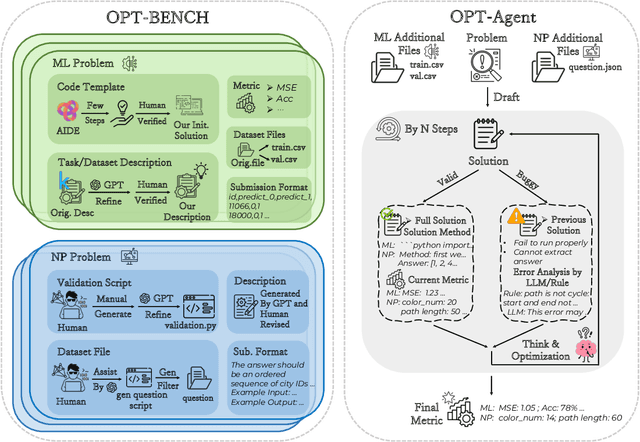
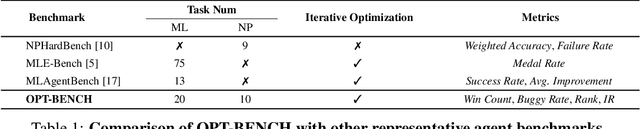
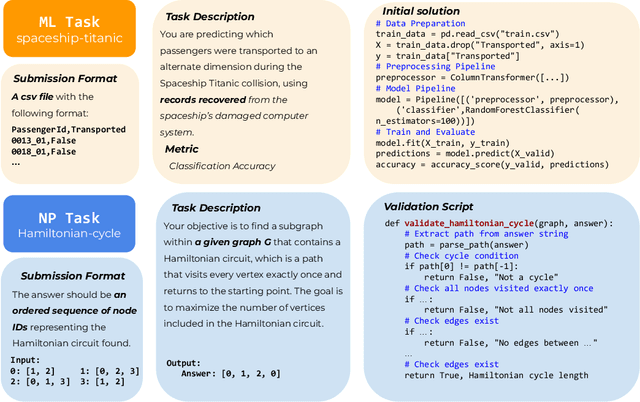
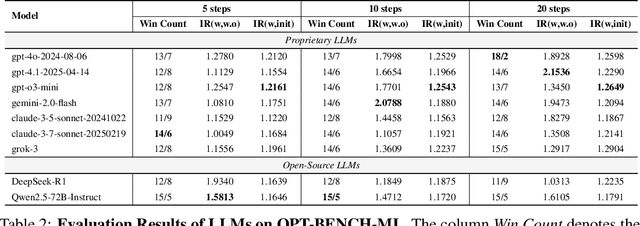
Large Language Models (LLMs) have shown remarkable capabilities in solving diverse tasks. However, their proficiency in iteratively optimizing complex solutions through learning from previous feedback remains insufficiently explored. To bridge this gap, we present OPT-BENCH, a comprehensive benchmark designed to evaluate LLM agents on large-scale search space optimization problems. OPT-BENCH includes 20 real-world machine learning tasks sourced from Kaggle and 10 classical NP problems, offering a diverse and challenging environment for assessing LLM agents on iterative reasoning and solution refinement. To enable rigorous evaluation, we introduce OPT-Agent, an end-to-end optimization framework that emulates human reasoning when tackling complex problems by generating, validating, and iteratively improving solutions through leveraging historical feedback. Through extensive experiments on 9 state-of-the-art LLMs from 6 model families, we analyze the effects of optimization iterations, temperature settings, and model architectures on solution quality and convergence. Our results demonstrate that incorporating historical context significantly enhances optimization performance across both ML and NP tasks. All datasets, code, and evaluation tools are open-sourced to promote further research in advancing LLM-driven optimization and iterative reasoning. Project page: \href{https://github.com/OliverLeeXZ/OPT-BENCH}{https://github.com/OliverLeeXZ/OPT-BENCH}.
Scaling Computer-Use Grounding via User Interface Decomposition and Synthesis
May 19, 2025Graphical user interface (GUI) grounding, the ability to map natural language instructions to specific actions on graphical user interfaces, remains a critical bottleneck in computer use agent development. Current benchmarks oversimplify grounding tasks as short referring expressions, failing to capture the complexity of real-world interactions that require software commonsense, layout understanding, and fine-grained manipulation capabilities. To address these limitations, we introduce OSWorld-G, a comprehensive benchmark comprising 564 finely annotated samples across diverse task types including text matching, element recognition, layout understanding, and precise manipulation. Additionally, we synthesize and release the largest computer use grounding dataset Jedi, which contains 4 million examples through multi-perspective decoupling of tasks. Our multi-scale models trained on Jedi demonstrate its effectiveness by outperforming existing approaches on ScreenSpot-v2, ScreenSpot-Pro, and our OSWorld-G. Furthermore, we demonstrate that improved grounding with Jedi directly enhances agentic capabilities of general foundation models on complex computer tasks, improving from 5% to 27% on OSWorld. Through detailed ablation studies, we identify key factors contributing to grounding performance and verify that combining specialized data for different interface elements enables compositional generalization to novel interfaces. All benchmark, data, checkpoints, and code are open-sourced and available at https://osworld-grounding.github.io.
Wan: Open and Advanced Large-Scale Video Generative Models
Mar 26, 2025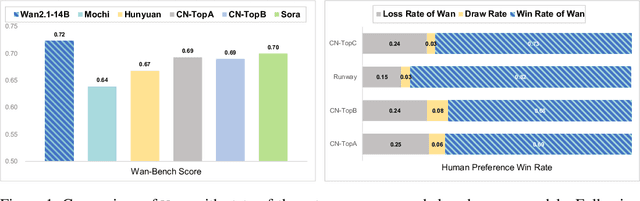
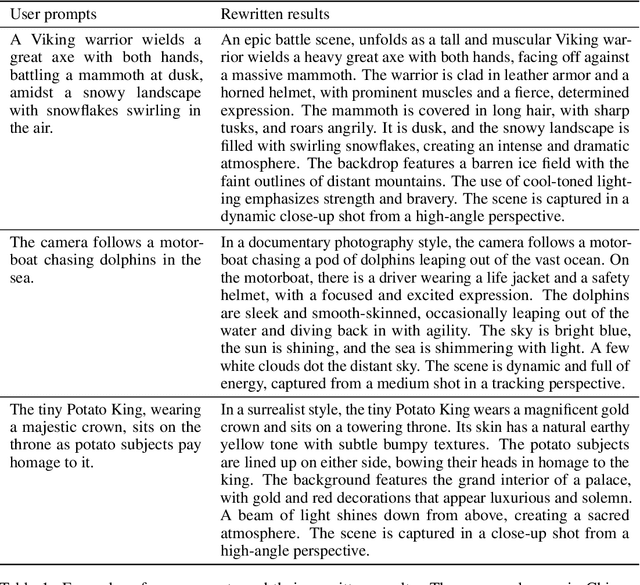

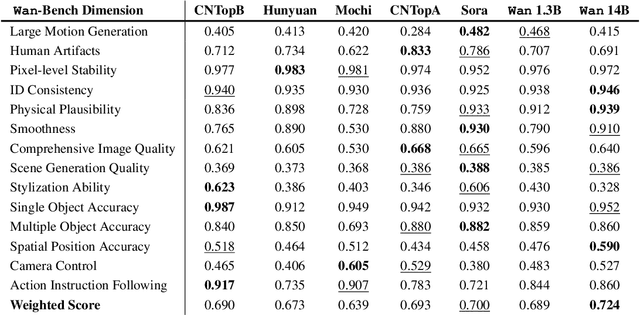
This report presents Wan, a comprehensive and open suite of video foundation models designed to push the boundaries of video generation. Built upon the mainstream diffusion transformer paradigm, Wan achieves significant advancements in generative capabilities through a series of innovations, including our novel VAE, scalable pre-training strategies, large-scale data curation, and automated evaluation metrics. These contributions collectively enhance the model's performance and versatility. Specifically, Wan is characterized by four key features: Leading Performance: The 14B model of Wan, trained on a vast dataset comprising billions of images and videos, demonstrates the scaling laws of video generation with respect to both data and model size. It consistently outperforms the existing open-source models as well as state-of-the-art commercial solutions across multiple internal and external benchmarks, demonstrating a clear and significant performance superiority. Comprehensiveness: Wan offers two capable models, i.e., 1.3B and 14B parameters, for efficiency and effectiveness respectively. It also covers multiple downstream applications, including image-to-video, instruction-guided video editing, and personal video generation, encompassing up to eight tasks. Consumer-Grade Efficiency: The 1.3B model demonstrates exceptional resource efficiency, requiring only 8.19 GB VRAM, making it compatible with a wide range of consumer-grade GPUs. Openness: We open-source the entire series of Wan, including source code and all models, with the goal of fostering the growth of the video generation community. This openness seeks to significantly expand the creative possibilities of video production in the industry and provide academia with high-quality video foundation models. All the code and models are available at https://github.com/Wan-Video/Wan2.1.
What Is a Good Caption? A Comprehensive Visual Caption Benchmark for Evaluating Both Correctness and Coverage of MLLMs
Feb 19, 2025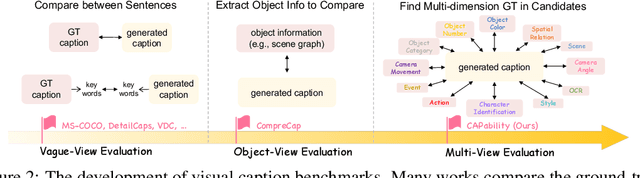
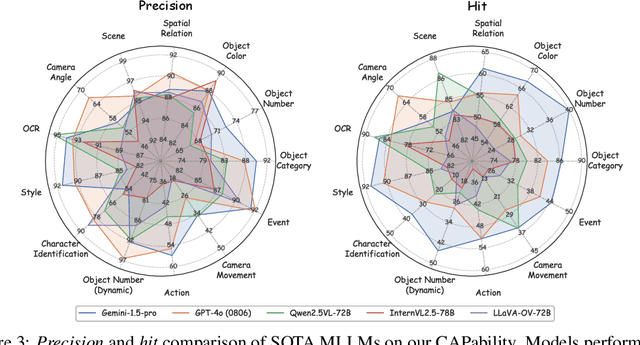
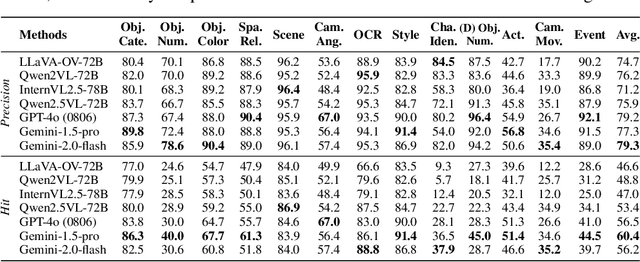

Recent advancements in Multimodal Large Language Models (MLLMs) have rendered traditional visual captioning benchmarks obsolete, as they primarily evaluate short descriptions with outdated metrics. While recent benchmarks address these limitations by decomposing captions into visual elements and adopting model-based evaluation, they remain incomplete-overlooking critical aspects, while providing vague, non-explanatory scores. To bridge this gap, we propose CV-CapBench, a Comprehensive Visual Caption Benchmark that systematically evaluates caption quality across 6 views and 13 dimensions. CV-CapBench introduces precision, recall, and hit rate metrics for each dimension, uniquely assessing both correctness and coverage. Experiments on leading MLLMs reveal significant capability gaps, particularly in dynamic and knowledge-intensive dimensions. These findings provide actionable insights for future research. The code and data will be released.
Spider 2.0: Evaluating Language Models on Real-World Enterprise Text-to-SQL Workflows
Nov 12, 2024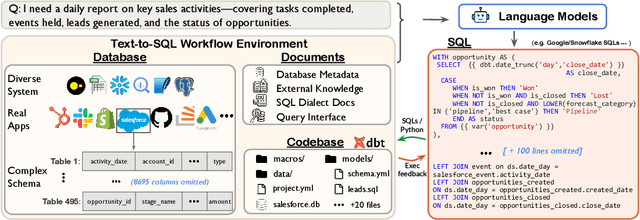
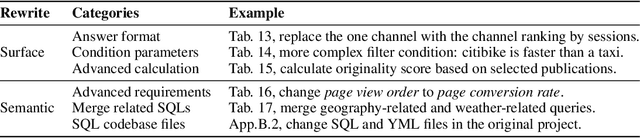


Real-world enterprise text-to-SQL workflows often involve complex cloud or local data across various database systems, multiple SQL queries in various dialects, and diverse operations from data transformation to analytics. We introduce Spider 2.0, an evaluation framework comprising 632 real-world text-to-SQL workflow problems derived from enterprise-level database use cases. The databases in Spider 2.0 are sourced from real data applications, often containing over 1,000 columns and stored in local or cloud database systems such as BigQuery and Snowflake. We show that solving problems in Spider 2.0 frequently requires understanding and searching through database metadata, dialect documentation, and even project-level codebases. This challenge calls for models to interact with complex SQL workflow environments, process extremely long contexts, perform intricate reasoning, and generate multiple SQL queries with diverse operations, often exceeding 100 lines, which goes far beyond traditional text-to-SQL challenges. Our evaluations indicate that based on o1-preview, our code agent framework successfully solves only 17.0% of the tasks, compared with 91.2% on Spider 1.0 and 73.0% on BIRD. Our results on Spider 2.0 show that while language models have demonstrated remarkable performance in code generation -- especially in prior text-to-SQL benchmarks -- they require significant improvement in order to achieve adequate performance for real-world enterprise usage. Progress on Spider 2.0 represents crucial steps towards developing intelligent, autonomous, code agents for real-world enterprise settings. Our code, baseline models, and data are available at https://spider2-sql.github.io.
COMMA: A Communicative Multimodal Multi-Agent Benchmark
Oct 10, 2024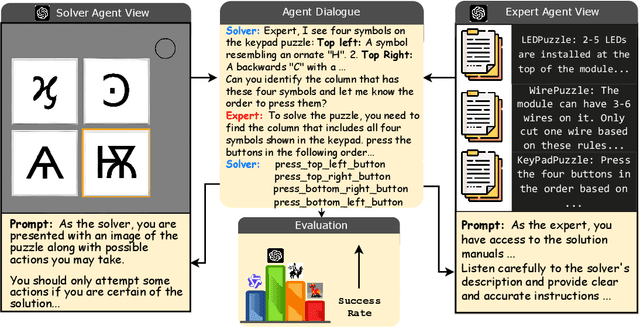

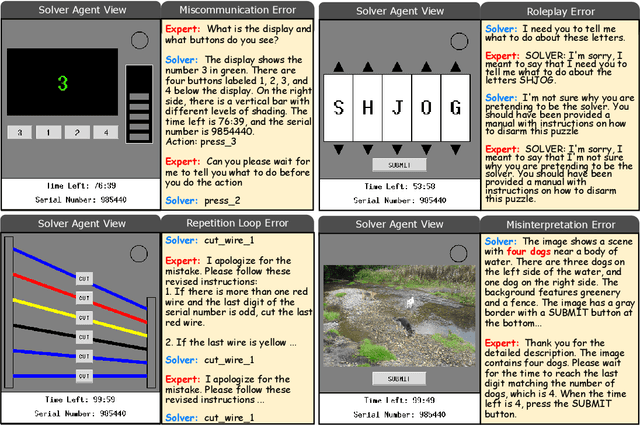
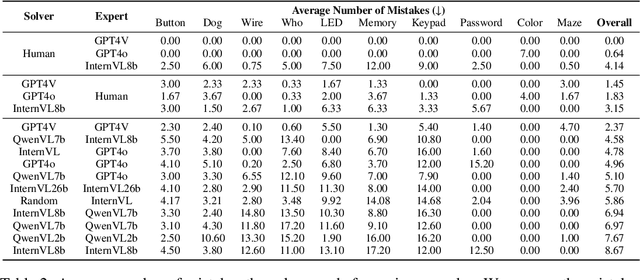
The rapid advances of multi-modal agents built on large foundation models have largely overlooked their potential for language-based communication between agents in collaborative tasks. This oversight presents a critical gap in understanding their effectiveness in real-world deployments, particularly when communicating with humans. Existing agentic benchmarks fail to address key aspects of inter-agent communication and collaboration, particularly in scenarios where agents have unequal access to information and must work together to achieve tasks beyond the scope of individual capabilities. To fill this gap, we introduce a novel benchmark designed to evaluate the collaborative performance of multimodal multi-agent systems through language communication. Our benchmark features a variety of scenarios, providing a comprehensive evaluation across four key categories of agentic capability in a communicative collaboration setting. By testing both agent-agent and agent-human collaborations using open-source and closed-source models, our findings reveal surprising weaknesses in state-of-the-art models, including proprietary models like GPT-4o. These models struggle to outperform even a simple random agent baseline in agent-agent collaboration and only surpass the random baseline when a human is involved.