 Add to Chrome
 Add to Firefox
 Add to Edge
Dialectic-Med: Mitigating Diagnostic Hallucinations via Counterfactual Adversarial Multi-Agent Debate
Apr 13, 2026
Multimodal Large Language Models (MLLMs) in healthcare suffer from severe confirmation bias, often hallucinating visual details to support initial, potentially erroneous diagnostic hypotheses. Existing Chain-of-Thought (CoT) approaches lack intrinsic correction mechanisms, rendering them vulnerable to error propagation. To bridge this gap, we propose Dialectic-Med, a multi-agent framework that enforces diagnostic rigor through adversarial dialectics. Unlike static consensus models, Dialectic-Med orchestrates a dynamic interplay between three role-specialized agents: a proponent that formulates diagnostic hypotheses; an opponent equipped with a novel visual falsification module that actively retrieves contradictory visual evidence to challenge the Proponent; and a mediator that resolves conflicts via a weighted consensus graph. By explicitly modeling the cognitive process of falsification, our framework guarantees that diagnostic reasoning is tightly grounded in verified visual regions. Empirical evaluations on MIMIC-CXR-VQA, VQA-RAD, and PathVQA demonstrate that Dialectic-Med not only achieves state-of-the-art performance but also fundamentally enhances the trustworthiness of the reasoning process. Beyond accuracy, our approach significantly enhances explanation faithfulness and decisively mitigates hallucinations, establishing a new standard over single-agent baselines.

Attention-Guided Flow-Matching for Sparse 3D Geological Generation
Apr 07, 2026Constructing high-resolution 3D geological models from sparse 1D borehole and 2D surface data is a highly ill-posed inverse problem. Traditional heuristic and implicit modeling methods fundamentally fail to capture non-linear topological discontinuities under extreme sparsity, often yielding unrealistic artifacts. Furthermore, while deep generative architectures like Diffusion Models have revolutionized continuous domains, they suffer from severe representation collapse when conditioned on sparse categorical grids. To bridge this gap, we propose 3D-GeoFlow, the first Attention-Guided Continuous Flow Matching framework tailored for sparse multimodal geological modeling. By reformulating discrete categorical generation as a simulation-free, continuous vector field regression optimized via Mean Squared Error, our model establishes stable, deterministic optimal transport paths. Crucially, we integrate 3D Attention Gates to dynamically propagate localized borehole features across the volumetric latent space, ensuring macroscopic structural coherence. To validate our framework, we curated a large-scale multimodal dataset comprising 2,200 procedurally generated 3D geological cases. Extensive out-of-distribution (OOD) evaluations demonstrate that 3D-GeoFlow achieves a paradigm shift, significantly outperforming heuristic interpolations and standard diffusion baselines.
Semantic-Topological Graph Reasoning for Language-Guided Pulmonary Screening
Apr 07, 2026Medical image segmentation driven by free-text clinical instructions is a critical frontier in computer-aided diagnosis. However, existing multimodal and foundation models struggle with the semantic ambiguity of clinical reports and fail to disambiguate complex anatomical overlaps in low-contrast scans. Furthermore, fully fine-tuning these massive architectures on limited medical datasets invariably leads to severe overfitting. To address these challenges, we propose a novel Semantic-Topological Graph Reasoning (STGR) framework for language-guided pulmonary screening. Our approach elegantly synergizes the reasoning capabilities of large language models (LLaMA-3-V) with the zero-shot delineation of vision foundation models (MedSAM). Specifically, we introduce a Text-to-Vision Intent Distillation (TVID) module to extract precise diagnostic guidance. To resolve anatomical ambiguity, we formulate mask selection as a dynamic graph reasoning problem, where candidate lesions are modeled as nodes and edges capture spatial and semantic affinities. To ensure deployment feasibility, we introduce a Selective Asymmetric Fine-Tuning (SAFT) strategy that updates less than 1% of the parameters. Rigorous 5-fold cross-validation on the LIDC-IDRI and LNDb datasets demonstrates that our framework establishes a new state-of-the-art. Notably, it achieves an 81.5% Dice Similarity Coefficient (DSC) on LIDC-IDRI, outperforming leading LLM-based tools like LISA by over 5%. Crucially, our SAFT strategy acts as a powerful regularizer, yielding exceptional cross-fold stability (0.6% DSC variance) and paving the way for robust, context-aware clinical deployment.
MERIT: Multilingual Expert-Reward Informed Tuning for Chinese-Centric Low-Resource Machine Translation
Apr 06, 2026Neural machine translation (NMT) from Chinese to low-resource Southeast Asian languages remains severely constrained by the extreme scarcity of clean parallel corpora and the pervasive noise in existing mined data. This chronic shortage not only impedes effective model training but also sustains a large performance gap with high-resource directions, leaving millions of speakers of languages such as Lao, Burmese, and Tagalog with persistently low-quality translation systems despite recent advances in large multilingual models. We introduce \textbf{M}ultilingual \textbf{E}xpert-\textbf{R}eward \textbf{I}nformed \textbf{T}uning (\textbf{MERIT}), a unified translation framework that transforms the traditional English-centric ALT benchmark into a Chinese-centric evaluation suite for five Southeast Asian low-resource languages (LRLs). Our framework combines language-specific token prefixing (LTP) with supervised fine-tuning (SFT) and a novel group relative policy optimization (GRPO) guided by the semantic alignment reward (SAR). These results confirm that, in LRL{\textrightarrow}Chinese translation, targeted data curation and reward-guided optimization dramatically outperform mere model scaling.
SkinCLIP-VL: Consistency-Aware Vision-Language Learning for Multimodal Skin Cancer Diagnosis
Mar 22, 2026The deployment of vision-language models (VLMs) in dermatology is hindered by the trilemma of high computational costs, extreme data scarcity, and the black-box nature of deep learning. To address these challenges, we present SkinCLIP-VL, a resource-efficient framework that adapts foundation models for trustworthy skin cancer diagnosis. Adopting a frozen perception, adaptive reasoning paradigm, we integrate a frozen CLIP encoder with a lightweight, quantized Qwen2.5-VL via low-rank adaptation (LoRA). To strictly align visual regions with clinical semantics under long-tailed distributions, we propose the Consistency-aware Focal Alignment (CFA) Loss. This objective synergizes focal re-weighting, semantic alignment, and calibration. On ISIC and Derm7pt benchmarks, SkinCLIP-VL surpasses 13B-parameter baselines by 4.3-6.2% in accuracy with 43% fewer parameters. Crucially, blinded expert evaluation and out-of-distribution testing confirm that our visually grounded rationales significantly enhance clinical trust compared to traditional saliency maps.
SAGE: Sustainable Agent-Guided Expert-tuning for Culturally Attuned Translation in Low-Resource Southeast Asia
Mar 20, 2026The vision of an inclusive World Wide Web is impeded by a severe linguistic divide, particularly for communities in low-resource regions of Southeast Asia. While large language models (LLMs) offer a potential solution for translation, their deployment in data-poor contexts faces a dual challenge: the scarcity of high-quality, culturally relevant data and the prohibitive energy costs of training on massive, noisy web corpora. To resolve the tension between digital inclusion and environmental sustainability, we introduce Sustainable Agent-Guided Expert-tuning (SAGE). This framework pioneers an energy-aware paradigm that prioritizes the "right data" over "big data". Instead of carbon-intensive training on unfiltered datasets, SAGE employs a reinforcement learning (RL) agent, optimized via Group Relative Policy Optimization (GRPO), to autonomously curate a compact training set. The agent utilizes a semantic reward signal derived from a small, expert-constructed set of community dialogues to filter out noise and cultural misalignment. We then efficiently fine-tune open-source LLMs on this curated data using Low-Rank Adaptation (LoRA). We applied SAGE to translation tasks between English and seven low-resource languages (LRLs) in Southeast Asia. Our approach establishes new state-of-the-art performance on BLEU-4 and COMET-22 metrics, effectively capturing local linguistic nuances. Crucially, SAGE surpasses baselines trained on full datasets while reducing data usage by 97.1% and training energy consumption by 95.2%. By delivering high-performance models with a minimal environmental footprint, SAGE offers a scalable and responsible pathway to bridge the digital divide in the Global South.
SAMP-HDRL: Segmented Allocation with Momentum-Adjusted Utility for Multi-agent Portfolio Management via Hierarchical Deep Reinforcement Learning
Dec 28, 2025Portfolio optimization in non-stationary markets is challenging due to regime shifts, dynamic correlations, and the limited interpretability of deep reinforcement learning (DRL) policies. We propose a Segmented Allocation with Momentum-Adjusted Utility for Multi-agent Portfolio Management via Hierarchical Deep Reinforcement Learning (SAMP-HDRL). The framework first applies dynamic asset grouping to partition the market into high-quality and ordinary subsets. An upper-level agent extracts global market signals, while lower-level agents perform intra-group allocation under mask constraints. A utility-based capital allocation mechanism integrates risky and risk-free assets, ensuring coherent coordination between global and local decisions. backtests across three market regimes (2019--2021) demonstrate that SAMP-HDRL consistently outperforms nine traditional baselines and nine DRL benchmarks under volatile and oscillating conditions. Compared with the strongest baseline, our method achieves at least 5\% higher Return, 5\% higher Sharpe ratio, 5\% higher Sortino ratio, and 2\% higher Omega ratio, with substantially larger gains observed in turbulent markets. Ablation studies confirm that upper--lower coordination, dynamic clustering, and capital allocation are indispensable to robustness. SHAP-based interpretability further reveals a complementary ``diversified + concentrated'' mechanism across agents, providing transparent insights into decision-making. Overall, SAMP-HDRL embeds structural market constraints directly into the DRL pipeline, offering improved adaptability, robustness, and interpretability in complex financial environments.
PRISM: A Personality-Driven Multi-Agent Framework for Social Media Simulation
Dec 22, 2025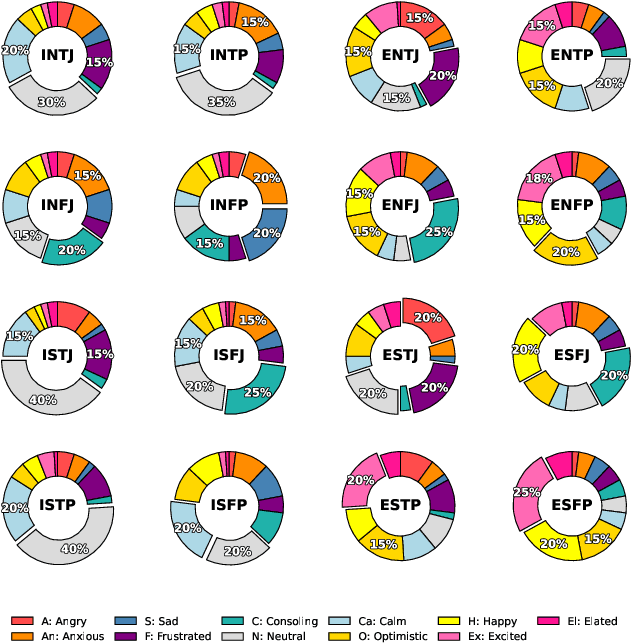
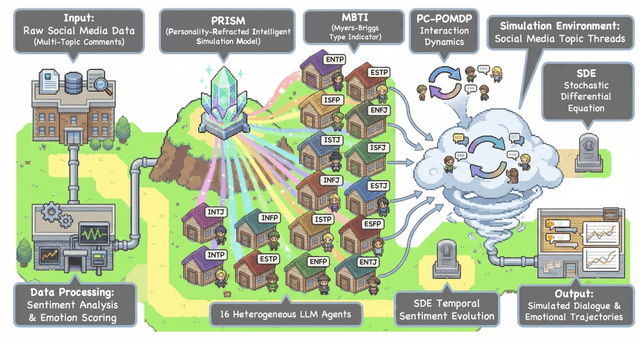
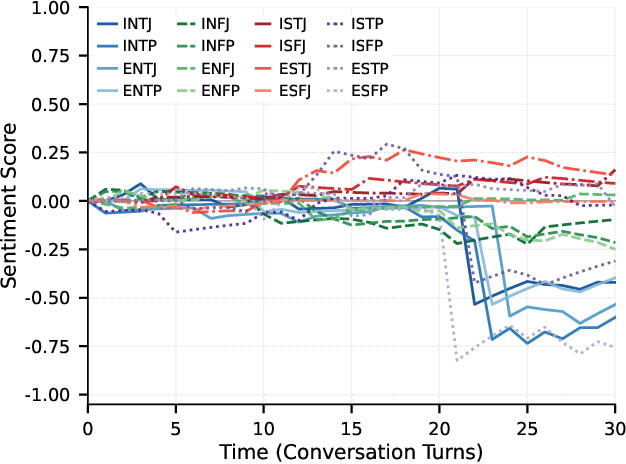
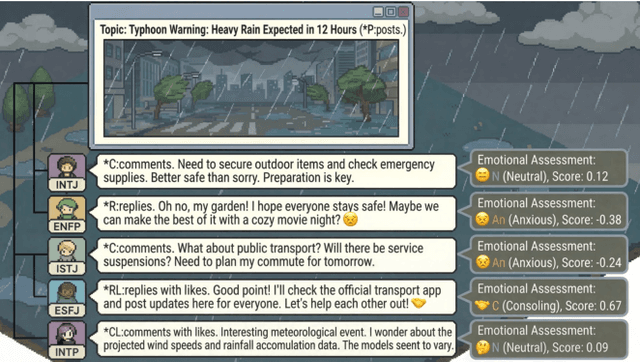
Traditional agent-based models (ABMs) of opinion dynamics often fail to capture the psychological heterogeneity driving online polarization due to simplistic homogeneity assumptions. This limitation obscures the critical interplay between individual cognitive biases and information propagation, thereby hindering a mechanistic understanding of how ideological divides are amplified. To address this challenge, we introduce the Personality-Refracted Intelligent Simulation Model (PRISM), a hybrid framework coupling stochastic differential equations (SDE) for continuous emotional evolution with a personality-conditional partially observable Markov decision process (PC-POMDP) for discrete decision-making. In contrast to continuous trait approaches, PRISM assigns distinct Myers-Briggs Type Indicator (MBTI) based cognitive policies to multimodal large language model (MLLM) agents, initialized via data-driven priors from large-scale social media datasets. PRISM achieves superior personality consistency aligned with human ground truth, significantly outperforming standard homogeneous and Big Five benchmarks. This framework effectively replicates emergent phenomena such as rational suppression and affective resonance, offering a robust tool for analyzing complex social media ecosystems.
Silhouette-to-Contour Registration: Aligning Intraoral Scan Models with Cephalometric Radiographs
Nov 18, 2025Reliable 3D-2D alignment between intraoral scan (IOS) models and lateral cephalometric radiographs is critical for orthodontic diagnosis, yet conventional intensity-driven registration methods struggle under real clinical conditions, where cephalograms exhibit projective magnification, geometric distortion, low-contrast dental crowns, and acquisition-dependent variation. These factors hinder the stability of appearance-based similarity metrics and often lead to convergence failures or anatomically implausible alignments. To address these limitations, we propose DentalSCR, a pose-stable, contour-guided framework for accurate and interpretable silhouette-to-contour registration. Our method first constructs a U-Midline Dental Axis (UMDA) to establish a unified cross-arch anatomical coordinate system, thereby stabilizing initialization and standardizing projection geometry across cases. Using this reference frame, we generate radiograph-like projections via a surface-based DRR formulation with coronal-axis perspective and Gaussian splatting, which preserves clinical source-object-detector magnification and emphasizes external silhouettes. Registration is then formulated as a 2D similarity transform optimized with a symmetric bidirectional Chamfer distance under a hierarchical coarse-to-fine schedule, enabling both large capture range and subpixel-level contour agreement. We evaluate DentalSCR on 34 expert-annotated clinical cases. Experimental results demonstrate substantial reductions in landmark error-particularly at posterior teeth-tighter dispersion on the lower jaw, and low Chamfer and controlled Hausdorff distances at the curve level. These findings indicate that DentalSCR robustly handles real-world cephalograms and delivers high-fidelity, clinically inspectable 3D--2D alignment, outperforming conventional baselines.
ArchMap: Arch-Flattening and Knowledge-Guided Vision Language Model for Tooth Counting and Structured Dental Understanding
Nov 18, 2025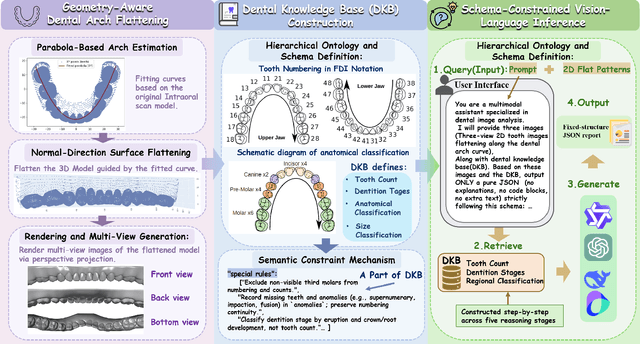
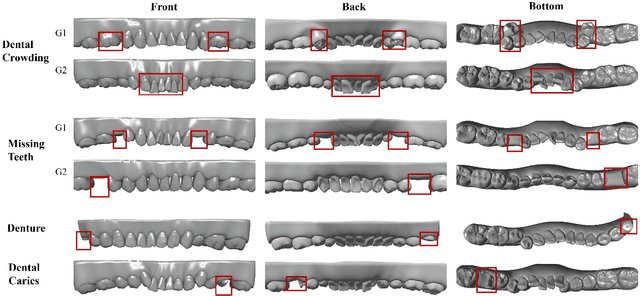
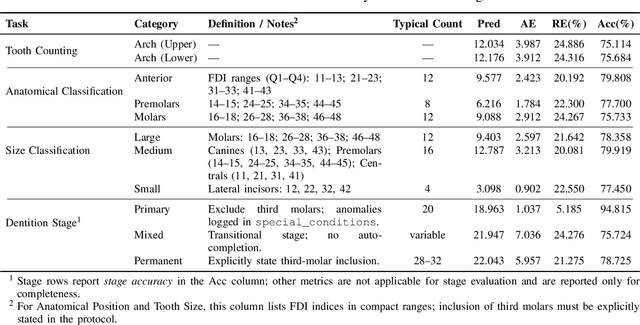
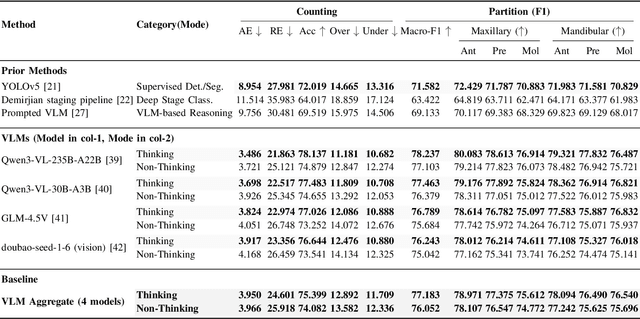
A structured understanding of intraoral 3D scans is essential for digital orthodontics. However, existing deep-learning approaches rely heavily on modality-specific training, large annotated datasets, and controlled scanning conditions, which limit generalization across devices and hinder deployment in real clinical workflows. Moreover, raw intraoral meshes exhibit substantial variation in arch pose, incomplete geometry caused by occlusion or tooth contact, and a lack of texture cues, making unified semantic interpretation highly challenging. To address these limitations, we propose ArchMap, a training-free and knowledge-guided framework for robust structured dental understanding. ArchMap first introduces a geometry-aware arch-flattening module that standardizes raw 3D meshes into spatially aligned, continuity-preserving multi-view projections. We then construct a Dental Knowledge Base (DKB) encoding hierarchical tooth ontology, dentition-stage policies, and clinical semantics to constrain the symbolic reasoning space. We validate ArchMap on 1060 pre-/post-orthodontic cases, demonstrating robust performance in tooth counting, anatomical partitioning, dentition-stage classification, and the identification of clinical conditions such as crowding, missing teeth, prosthetics, and caries. Compared with supervised pipelines and prompted VLM baselines, ArchMap achieves higher accuracy, reduced semantic drift, and superior stability under sparse or artifact-prone conditions. As a fully training-free system, ArchMap demonstrates that combining geometric normalization with ontology-guided multimodal reasoning offers a practical and scalable solution for the structured analysis of 3D intraoral scans in modern digital orthodontics.