 Add to Chrome
 Add to Firefox
 Add to Edge
RADD: Retrieval-Augmented Discrete Diffusion for Multi-Modal Knowledge Graph Completion
Apr 28, 2026
Most multi-modal knowledge graph completion (MMKGC) models use one embedding scorer to do both retrieval over the full entity set and final decision making. We argue that this coupling is a core bottleneck: global high-recall search and local fine-grained disambiguation require different inductive biases. Therefore, we propose a Retrieval-Augmented Discrete Diffusion (RADD) framework to decouple retrieve and reranking for MMKGC. A relation-aware multimodal KGE retriever serves as both global retriever and distillation teacher, while a conditional discrete denoiser performs shortlist-level entity-identity generation for reranking. Training combines KGE supervision, denoising cross-entropy, and temperature-scaled distillation from the retriever to the denoiser. At inference, the designed Diff-Rerank first forms a top-$K$ shortlist with the retriever and then reranks it with the denoiser, ensuring that recall is a strict prerequisite for precision. Experiments on three MMKGC benchmarks show that RADD achieves the best performance and consistent gains over strong unimodal, multimodal, and LLM-based baselines, while ablations further verify the contribution of each component.

Towards Robust Text-to-Image Person Retrieval: Multi-View Reformulation for Semantic Compensation
Apr 20, 2026In text-to-image person retrieval tasks, the diversity of natural language expressions and the implicitness of visual semantics often lead to the problem of Expression Drift, where semantically equivalent texts exhibit significant feature discrepancies in the embedding space due to phrasing variations, thereby degrading the robustness of image-text alignment. This paper proposes a semantic compensation framework (MVR) driven by Large Language Models (LLMs), which enhances cross-modal representation consistency through multi-view semantic reformulation and feature compensation. The core methodology comprises three components: Multi-View Reformulation (MVR): A dual-branch prompting strategy combines key feature guidance (extracting visually critical components via feature similarity) and diversity-aware rewriting to generate semantically equivalent yet distributionally diverse textual variants; Textual Feature Robustness Enhancement: A training-free latent space compensation mechanism suppresses noise interference through multi-view feature mean-pooling and residual connections, effectively capturing "Semantic Echoes"; Visual Semantic Compensation: VLM generates multi-perspective image descriptions, which are further enhanced through shared text reformulation to address visual semantic gaps. Experiments demonstrate that our method can improve the accuracy of the original model well without training and performs SOTA on three text-to-image person retrieval datasets.
CMCC-ReID: Cross-Modality Clothing-Change Person Re-Identification
Apr 03, 2026Person Re-Identification (ReID) faces severe challenges from modality discrepancy and clothing variation in long-term surveillance scenario. While existing studies have made significant progress in either Visible-Infrared ReID (VI-ReID) or Clothing-Change ReID (CC-ReID), real-world surveillance system often face both challenges simultaneously. To address this overlooked yet realistic problem, we define a new task, termed Cross-Modality Clothing-Change Re-Identification (CMCC-ReID), which targets pedestrian matching across variations in both modality and clothing. To advance research in this direction, we construct a new benchmark SYSU-CMCC, where each identity is captured in both visible and infrared domains with distinct outfits, reflecting the dual heterogeneity of long-term surveillance. To tackle CMCC-ReID, we propose a Progressive Identity Alignment Network (PIA) that progressively mitigates the issues of clothing variation and modality discrepancy. Specifically, a Dual-Branch Disentangling Learning (DBDL) module separates identity-related cues from clothing-related factors to achieve clothing-agnostic representation, and a Bi-Directional Prototype Learning (BPL) module performs intra-modality and inter-modality contrast in the embedding space to bridge the modality gap while further suppressing clothing interference. Extensive experiments on the SYSU-CMCC dataset demonstrate that PIA establishes a strong baseline for this new task and significantly outperforms existing methods.
BIT: Matching-based Bi-directional Interaction Transformation Network for Visible-Infrared Person Re-Identification
Mar 15, 2026Visible-Infrared Person Re-Identification (VI-ReID) is a challenging retrieval task due to the substantial modality gap between visible and infrared images. While existing methods attempt to bridge this gap by learning modality-invariant features within a shared embedding space, they often overlook the complex and implicit correlations between modalities. This limitation becomes more severe under distribution shifts, where infrared samples are often far fewer than visible ones. To address these challenges, we propose a novel network termed Bi-directional Interaction Transformation (BIT). Instead of relying on rigid feature alignment, BIT adopts a matching-based strategy that explicitly models the interaction between visible and infrared image pairs. Specifically, BIT employs an encoder-decoder architecture where the encoder extracts preliminary feature representations, and the decoder performs bi-directional feature integration and query aware scoring to enhance cross-modality correspondence. To our best knowledge, BIT is the first to introduce such pairwise matching-driven interaction in VI-ReID. Extensive experiments on several benchmarks demonstrate that our BIT achieves state-of-the-art performance, highlighting its effectiveness in the VI-ReID task.
Tokenization, Fusion and Decoupling: Bridging the Granularity Mismatch Between Large Language Models and Knowledge Graphs
Feb 26, 2026Leveraging Large Language Models (LLMs) for Knowledge Graph Completion (KGC) is promising but hindered by a fundamental granularity mismatch. LLMs operate on fragmented token sequences, whereas entities are the fundamental units in knowledge graphs (KGs) scenarios. Existing approaches typically constrain predictions to limited candidate sets or align entities with the LLM's vocabulary by pooling multiple tokens or decomposing entities into fixed-length token sequences, which fail to capture both the semantic meaning of the text and the structural integrity of the graph. To address this, we propose KGT, a novel framework that uses dedicated entity tokens to enable efficient, full-space prediction. Specifically, we first introduce specialized tokenization to construct feature representations at the level of dedicated entity tokens. We then fuse pre-trained structural and textual features into these unified embeddings via a relation-guided gating mechanism, avoiding training from scratch. Finally, we implement decoupled prediction by leveraging independent heads to separate and combine semantic and structural reasoning. Experimental results show that KGT consistently outperforms state-of-the-art methods across multiple benchmarks.
IFEvalCode: Controlled Code Generation
Jul 30, 2025Code large language models (Code LLMs) have made significant progress in code generation by translating natural language descriptions into functional code; however, real-world applications often demand stricter adherence to detailed requirements such as coding style, line count, and structural constraints, beyond mere correctness. To address this, the paper introduces forward and backward constraints generation to improve the instruction-following capabilities of Code LLMs in controlled code generation, ensuring outputs align more closely with human-defined guidelines. The authors further present IFEvalCode, a multilingual benchmark comprising 1.6K test samples across seven programming languages (Python, Java, JavaScript, TypeScript, Shell, C++, and C#), with each sample featuring both Chinese and English queries. Unlike existing benchmarks, IFEvalCode decouples evaluation into two metrics: correctness (Corr.) and instruction-following (Instr.), enabling a more nuanced assessment. Experiments on over 40 LLMs reveal that closed-source models outperform open-source ones in controllable code generation and highlight a significant gap between the models' ability to generate correct code versus code that precisely follows instructions.
Neighbor-Based Feature and Index Enhancement for Person Re-Identification
Apr 16, 2025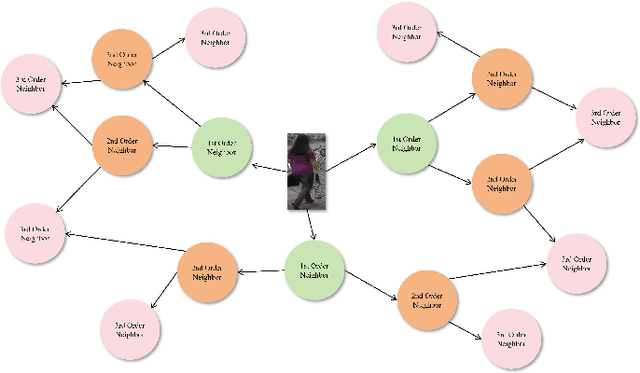
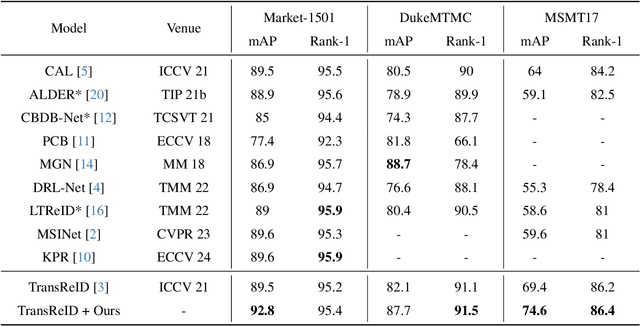
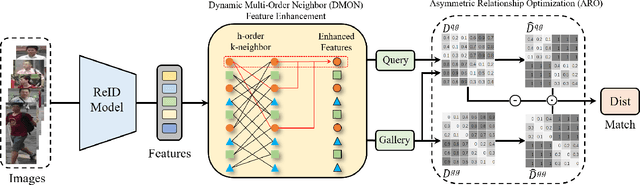
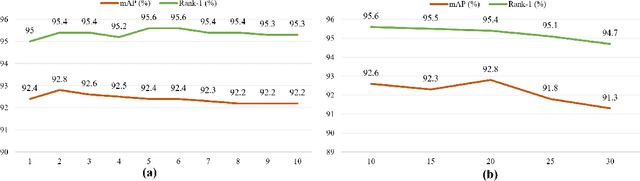
Person re-identification (Re-ID) aims to match the same pedestrian in a large gallery with different cameras and views. Enhancing the robustness of the extracted feature representations is a main challenge in Re-ID. Existing methods usually improve feature representation by improving model architecture, but most methods ignore the potential contextual information, which limits the effectiveness of feature representation and retrieval performance. Neighborhood information, especially the potential information of multi-order neighborhoods, can effectively enrich feature expression and improve retrieval accuracy, but this has not been fully explored in existing research. Therefore, we propose a novel model DMON-ARO that leverages latent neighborhood information to enhance both feature representation and index performance. Our approach is built on two complementary modules: Dynamic Multi-Order Neighbor Modeling (DMON) and Asymmetric Relationship Optimization (ARO). The DMON module dynamically aggregates multi-order neighbor relationships, allowing it to capture richer contextual information and enhance feature representation through adaptive neighborhood modeling. Meanwhile, ARO refines the distance matrix by optimizing query-to-gallery relationships, improving the index accuracy. Extensive experiments on three benchmark datasets demonstrate that our approach achieves performance improvements against baseline models, which illustrate the effectiveness of our model. Specifically, our model demonstrates improvements in Rank-1 accuracy and mAP. Moreover, this method can also be directly extended to other re-identification tasks.
From Poses to Identity: Training-Free Person Re-Identification via Feature Centralization
Mar 02, 2025
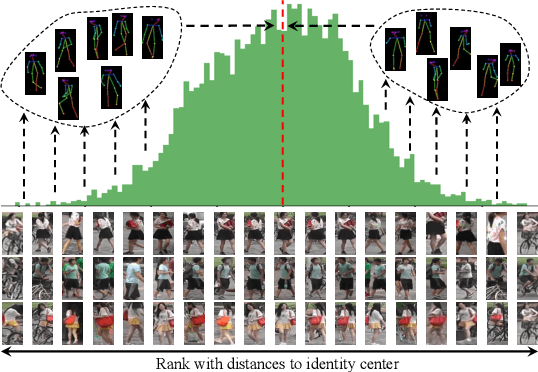
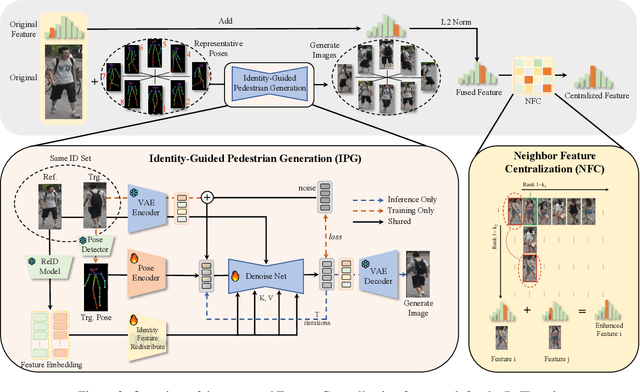
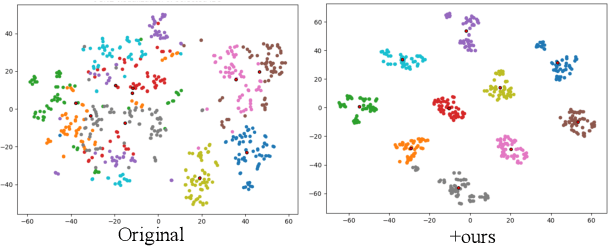
Person re-identification (ReID) aims to extract accurate identity representation features. However, during feature extraction, individual samples are inevitably affected by noise (background, occlusions, and model limitations). Considering that features from the same identity follow a normal distribution around identity centers after training, we propose a Training-Free Feature Centralization ReID framework (Pose2ID) by aggregating the same identity features to reduce individual noise and enhance the stability of identity representation, which preserves the feature's original distribution for following strategies such as re-ranking. Specifically, to obtain samples of the same identity, we introduce two components:Identity-Guided Pedestrian Generation: by leveraging identity features to guide the generation process, we obtain high-quality images with diverse poses, ensuring identity consistency even in complex scenarios such as infrared, and occlusion.Neighbor Feature Centralization: it explores each sample's potential positive samples from its neighborhood. Experiments demonstrate that our generative model exhibits strong generalization capabilities and maintains high identity consistency. With the Feature Centralization framework, we achieve impressive performance even with an ImageNet pre-trained model without ReID training, reaching mAP/Rank-1 of 52.81/78.92 on Market1501. Moreover, our method sets new state-of-the-art results across standard, cross-modality, and occluded ReID tasks, showcasing strong adaptability.
Diffusion-based Hierarchical Negative Sampling for Multimodal Knowledge Graph Completion
Jan 26, 2025Multimodal Knowledge Graph Completion (MMKGC) aims to address the critical issue of missing knowledge in multimodal knowledge graphs (MMKGs) for their better applications. However, both the previous MMGKC and negative sampling (NS) approaches ignore the employment of multimodal information to generate diverse and high-quality negative triples from various semantic levels and hardness levels, thereby limiting the effectiveness of training MMKGC models. Thus, we propose a novel Diffusion-based Hierarchical Negative Sampling (DHNS) scheme tailored for MMKGC tasks, which tackles the challenge of generating high-quality negative triples by leveraging a Diffusion-based Hierarchical Embedding Generation (DiffHEG) that progressively conditions on entities and relations as well as multimodal semantics. Furthermore, we develop a Negative Triple-Adaptive Training (NTAT) strategy that dynamically adjusts training margins associated with the hardness level of the synthesized negative triples, facilitating a more robust and effective learning procedure to distinguish between positive and negative triples. Extensive experiments on three MMKGC benchmark datasets demonstrate that our framework outperforms several state-of-the-art MMKGC models and negative sampling techniques, illustrating the effectiveness of our DHNS for training MMKGC models. The source codes and datasets of this paper are available at https://github.com/ngl567/DHNS.
Identity-aware Feature Decoupling Learning for Clothing-change Person Re-identification
Jan 10, 2025Clothing-change person re-identification (CC Re-ID) has attracted increasing attention in recent years due to its application prospect. Most existing works struggle to adequately extract the ID-related information from the original RGB images. In this paper, we propose an Identity-aware Feature Decoupling (IFD) learning framework to mine identity-related features. Particularly, IFD exploits a dual stream architecture that consists of a main stream and an attention stream. The attention stream takes the clothing-masked images as inputs and derives the identity attention weights for effectively transferring the spatial knowledge to the main stream and highlighting the regions with abundant identity-related information. To eliminate the semantic gap between the inputs of two streams, we propose a clothing bias diminishing module specific to the main stream to regularize the features of clothing-relevant regions. Extensive experimental results demonstrate that our framework outperforms other baseline models on several widely-used CC Re-ID datasets.