 Add to Chrome
 Add to Firefox
 Add to Edge
Chart-FR1: Visual Focus-Driven Fine-Grained Reasoning on Dense Charts
May 03, 2026
Multimodal large language models (MLLMs) have shown considerable potential in chart understanding and reasoning tasks. However, they still struggle with high information density (HID) charts characterized by multiple subplots, legends, and dense annotations due to three major challenges: (1) limited fine-grained perception results in the omission of critical visual cues; (2) redundant or noisy visual information undermines the performance of multimodal reasoning; (3) lack of adaptive deep reasoning relative to the amount of visual information. To tackle these challenges, we present a novel focus-driven fine-grained chart reasoning model, Chart-FR1, to improve perception, focusing efficiency, and adaptive deep reasoning on HID charts. Specifically, we propose Focus-CoT, a visual focusing chain-of-thought that enhances fine-grained perception by explicitly linking reasoning steps to key visual cues, such as local image regions and OCR signals. Building on this, we introduce Focus-GRPO, a focus-driven reinforcement learning algorithm with an information-efficiency reward that compresses redundant visual information for efficient focusing, and an adaptive KL penalty mechanism that enables flexible control over reasoning depth as more visual cues are discovered. Furthermore, to fill the gap in benchmarks for HID charts, we build HID-Chart, a challenging benchmark with an information-density metric designed to evaluate fine-grained chart reasoning capabilities. Extensive experiments on multiple chart benchmarks demonstrate that Chart-FR1 outperforms state-of-the-art MLLMs in chart understanding and reasoning. Code is available at https://github.com/phkhub/Chart-FR1.

Integrating Stock Features and Global Information via Large Language Models for Enhanced Stock Return Prediction
Oct 09, 2023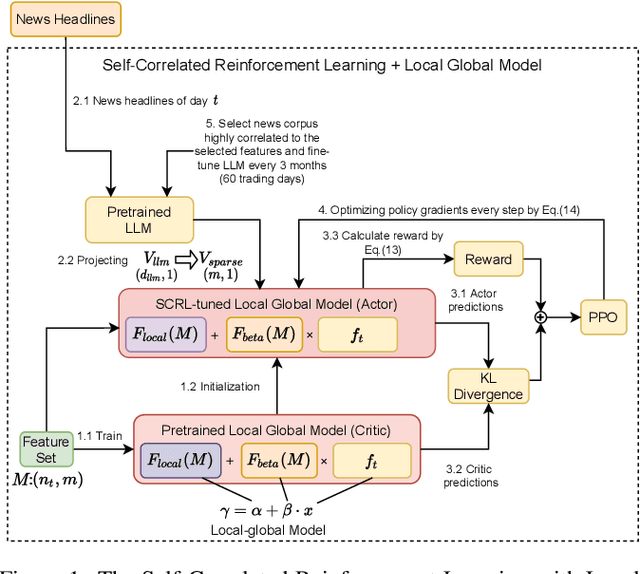

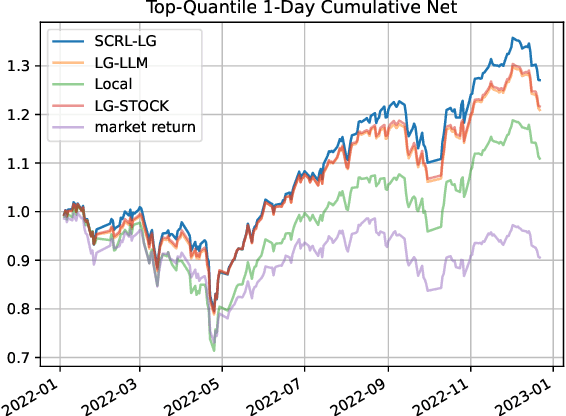
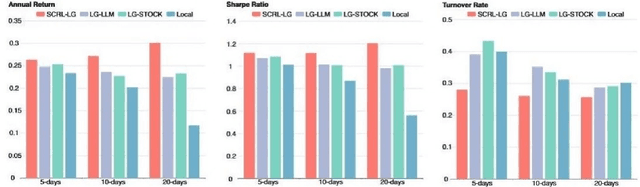
The remarkable achievements and rapid advancements of Large Language Models (LLMs) such as ChatGPT and GPT-4 have showcased their immense potential in quantitative investment. Traders can effectively leverage these LLMs to analyze financial news and predict stock returns accurately. However, integrating LLMs into existing quantitative models presents two primary challenges: the insufficient utilization of semantic information embedded within LLMs and the difficulties in aligning the latent information within LLMs with pre-existing quantitative stock features. We propose a novel framework consisting of two components to surmount these challenges. The first component, the Local-Global (LG) model, introduces three distinct strategies for modeling global information. These approaches are grounded respectively on stock features, the capabilities of LLMs, and a hybrid method combining the two paradigms. The second component, Self-Correlated Reinforcement Learning (SCRL), focuses on aligning the embeddings of financial news generated by LLMs with stock features within the same semantic space. By implementing our framework, we have demonstrated superior performance in Rank Information Coefficient and returns, particularly compared to models relying only on stock features in the China A-share market.
* 8 pages, International Joint Conferences on Artificial Intelligence