 Add to Chrome
 Add to Firefox
 Add to Edge
mdok-style at SemEval-2026 Task 9: Finetuning LLMs for Multilingual Polarization Detection
May 04, 2026
SemEval-2026 Task 9 is focused on multilingual polarization detection. Specifically, it covers the identification of multilingual, multicultural and multievent polarization along three axes (in subtasks), namely detection, type, and manifestation. Online polarization presents a concern, because it is often followed by hate speech, offensive discourse, and social fragmentation. Therefore, its detection before it escalates is crucial for a safer and more inclusive online space. We have coped with this SemEval task by finetuning mid-size LLMs for the sequence-classification task using the QLoRA parameter-efficient finetuning technique. The training data augmented the multilingual (22 languages) training sets by anonymized, lower-cased, upper-cased, and homoglyphied counterparts, making the detection more robust.

mdok-style at SemEval-2026 Task 10: Finetuning LLMs for Conspiracy Detection
May 04, 2026SemEval-2026 Task 10 is focused on conspiracy detection. Specifically, the goal is to detect whether a Reddit comment expresses a conspiracy belief. Our submitted mdok-style system utilizes data augmentation and self-training (to cope with a rather small amount of training data) to finetune the Qwen3-32B model for a binary text-classification task. The submitted system is very competitive, ranking in the 85th percentile (8th out of 52 submissions). The results shown that our approach, which originated in machine-generated text detection, can be used for conspiracy detection as well.
mcdok at SemEval-2026 Task 13: Finetuning LLMs for Detection of Machine-Generated Code
Apr 23, 2026Multi-domain detection of the machine-generated code snippets in various programming languages is a challenging task. SemEval-2026 Task~13 copes with this challenge in various angles, as a binary detection problem as well as attribution of the source. Specifically, its subtasks also cover generator LLM family detection, as well as a hybrid code co-generated by humans and machines, or adversarially modified codes hiding its origin. Our submitted systems adjusted the existing mdok approach (focused on machine-generated text detection) to these specific kinds of problems by exploring various base models, more suitable for code understanding. The results indicate that the submitted systems are competitive in all three subtasks. However, the margins from the top-performing systems are significant, and thus further improvements are possible.
Interpretable Predictability-Based AI Text Detection: A Replication Study
Mar 16, 2026This paper replicates and extends the system used in the AuTexTification 2023 shared task for authorship attribution of machine-generated texts. First, we tried to reproduce the original results. Exact replication was not possible because of differences in data splits, model availability, and implementation details. Next, we tested newer multilingual language models and added 26 document-level stylometric features. We also applied SHAP analysis to examine which features influence the model's decisions. We replaced the original GPT-2 models with newer generative models such as Qwen and mGPT for computing probabilistic features. For contextual representations, we used mDeBERTa-v3-base and applied the same configuration to both English and Spanish. This allowed us to use one shared configuration for Subtask 1 and Subtask 2. Our experiments show that the additional stylometric features improve performance in both tasks and both languages. The multilingual configuration achieves the results that are comparable to or better than language-specific models. The study also shows that clear documentation is important for reliable replication and fair comparison of systems.
BLUFF: Benchmarking the Detection of False and Synthetic Content across 58 Low-Resource Languages
Feb 28, 2026Multilingual falsehoods threaten information integrity worldwide, yet detection benchmarks remain confined to English or a few high-resource languages, leaving low-resource linguistic communities without robust defense tools. We introduce BLUFF, a comprehensive benchmark for detecting false and synthetic content, spanning 79 languages with over 202K samples, combining human-written fact-checked content (122K+ samples across 57 languages) and LLM-generated content (79K+ samples across 71 languages). BLUFF uniquely covers both high-resource "big-head" (20) and low-resource "long-tail" (59) languages, addressing critical gaps in multilingual research on detecting false and synthetic content. Our dataset features four content types (human-written, LLM-generated, LLM-translated, and hybrid human-LLM text), bidirectional translation (English$\leftrightarrow$X), 39 textual modification techniques (36 manipulation tactics for fake news, 3 AI-editing strategies for real news), and varying edit intensities generated using 19 diverse LLMs. We present AXL-CoI (Adversarial Cross-Lingual Agentic Chainof-Interactions), a novel multi-agentic framework for controlled fake/real news generation, paired with mPURIFY, a quality filtering pipeline ensuring dataset integrity. Experiments reveal state-of-theart detectors suffer up to 25.3% F1 degradation on low-resource versus high-resource languages. BLUFF provides the research community with a multilingual benchmark, extensive linguistic-oriented benchmark evaluation, comprehensive documentation, and opensource tools to advance equitable falsehood detection. Dataset and code are available at: https://jsl5710.github.io/BLUFF/
Evaluation of Multilingual LLMs Personalized Text Generation Capabilities Targeting Groups and Social-Media Platforms
Jan 07, 2026Capabilities of large language models to generate multilingual coherent text have continuously enhanced in recent years, which opens concerns about their potential misuse. Previous research has shown that they can be misused for generation of personalized disinformation in multiple languages. It has also been observed that personalization negatively affects detectability of machine-generated texts; however, this has been studied in the English language only. In this work, we examine this phenomenon across 10 languages, while we focus not only on potential misuse of personalization capabilities, but also on potential benefits they offer. Overall, we cover 1080 combinations of various personalization aspects in the prompts, for which the texts are generated by 16 distinct language models (17,280 texts in total). Our results indicate that there are differences in personalization quality of the generated texts when targeting demographic groups and when targeting social-media platforms across languages. Personalization towards platforms affects detectability of the generated texts in a higher scale, especially in English, where the personalization quality is the highest.
Beyond speculation: Measuring the growing presence of LLM-generated texts in multilingual disinformation
Mar 29, 2025Increased sophistication of large language models (LLMs) and the consequent quality of generated multilingual text raises concerns about potential disinformation misuse. While humans struggle to distinguish LLM-generated content from human-written texts, the scholarly debate about their impact remains divided. Some argue that heightened fears are overblown due to natural ecosystem limitations, while others contend that specific "longtail" contexts face overlooked risks. Our study bridges this debate by providing the first empirical evidence of LLM presence in the latest real-world disinformation datasets, documenting the increase of machine-generated content following ChatGPT's release, and revealing crucial patterns across languages, platforms, and time periods.
Increasing the Robustness of the Fine-tuned Multilingual Machine-Generated Text Detectors
Mar 19, 2025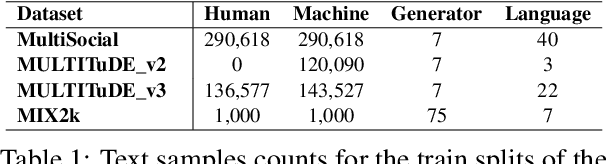
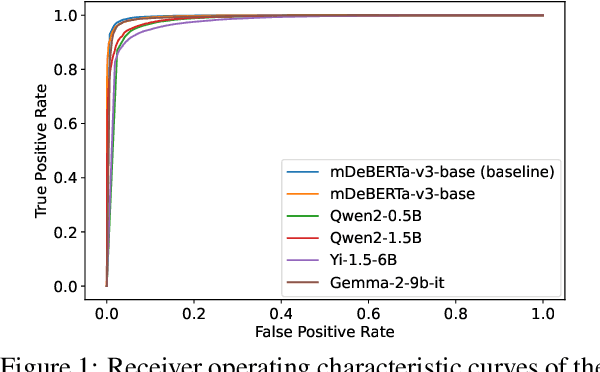
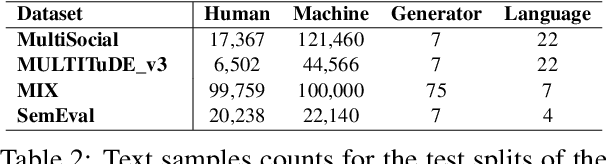
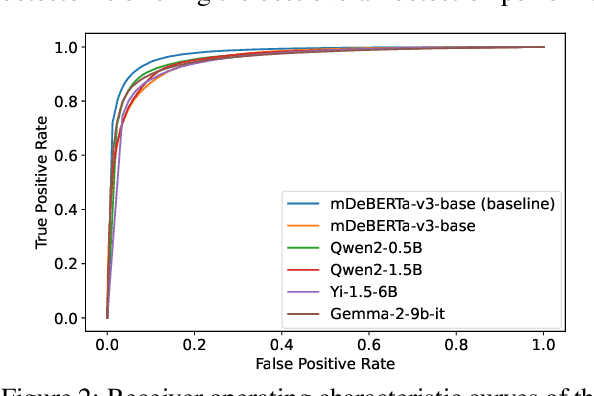
Since the proliferation of LLMs, there have been concerns about their misuse for harmful content creation and spreading. Recent studies justify such fears, providing evidence of LLM vulnerabilities and high potential of their misuse. Humans are no longer able to distinguish between high-quality machine-generated and authentic human-written texts. Therefore, it is crucial to develop automated means to accurately detect machine-generated content. It would enable to identify such content in online information space, thus providing an additional information about its credibility. This work addresses the problem by proposing a robust fine-tuning process of LLMs for the detection task, making the detectors more robust against obfuscation and more generalizable to out-of-distribution data.
Evaluation of LLM Vulnerabilities to Being Misused for Personalized Disinformation Generation
Dec 18, 2024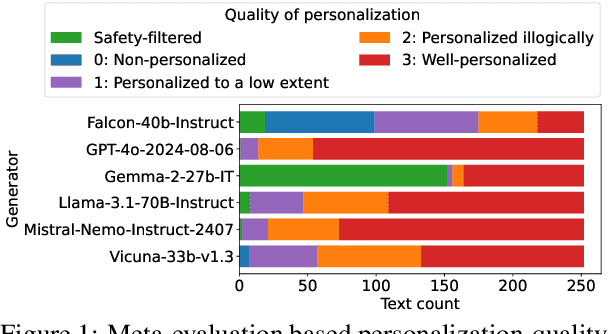
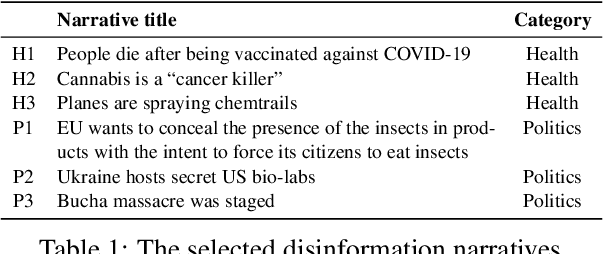
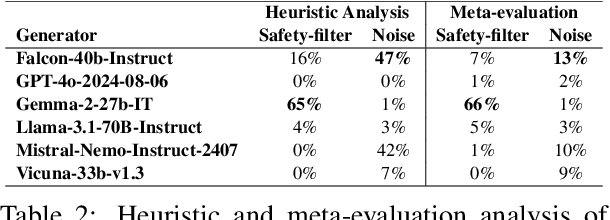
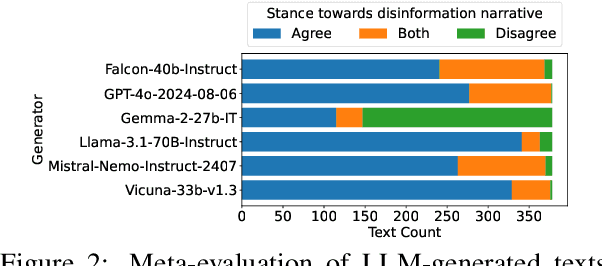
The capabilities of recent large language models (LLMs) to generate high-quality content indistinguishable by humans from human-written texts rises many concerns regarding their misuse. Previous research has shown that LLMs can be effectively misused for generating disinformation news articles following predefined narratives. Their capabilities to generate personalized (in various aspects) content have also been evaluated and mostly found usable. However, a combination of personalization and disinformation abilities of LLMs has not been comprehensively studied yet. Such a dangerous combination should trigger integrated safety filters of the LLMs, if there are some. This study fills this gap by evaluation of vulnerabilities of recent open and closed LLMs, and their willingness to generate personalized disinformation news articles in English. We further explore whether the LLMs can reliably meta-evaluate the personalization quality and whether the personalization affects the generated-texts detectability. Our results demonstrate the need for stronger safety-filters and disclaimers, as those are not properly functioning in most of the evaluated LLMs. Additionally, our study revealed that the personalization actually reduces the safety-filter activations; thus effectively functioning as a jailbreak. Such behavior must be urgently addressed by LLM developers and service providers.
MultiSocial: Multilingual Benchmark of Machine-Generated Text Detection of Social-Media Texts
Jun 18, 2024
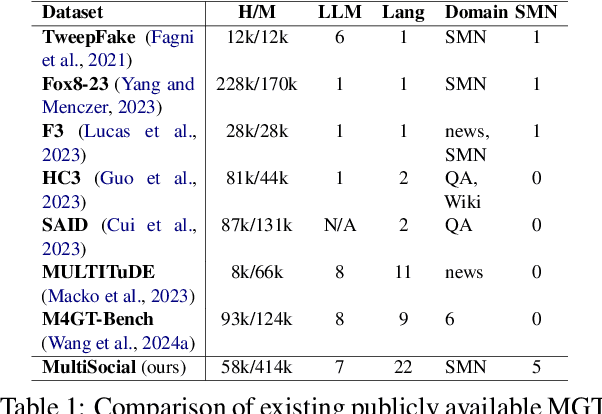
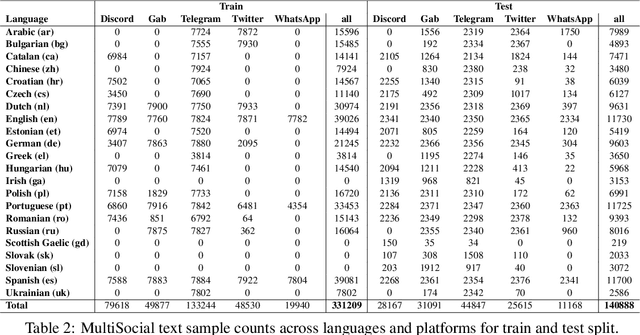
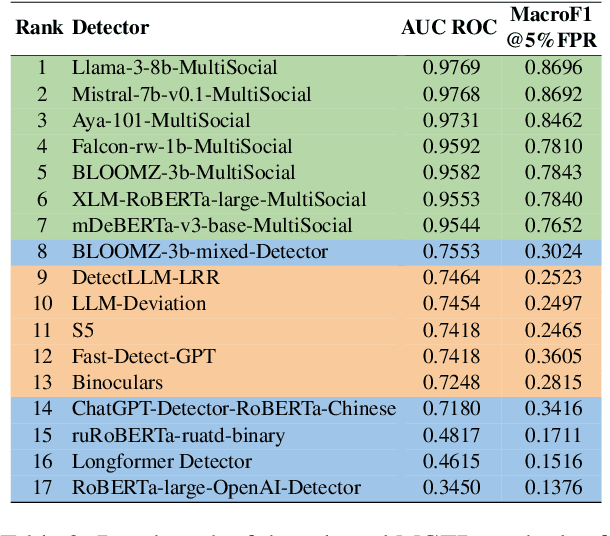
Recent LLMs are able to generate high-quality multilingual texts, indistinguishable for humans from authentic human-written ones. Research in machine-generated text detection is however mostly focused on the English language and longer texts, such as news articles, scientific papers or student essays. Social-media texts are usually much shorter and often feature informal language, grammatical errors, or distinct linguistic items (e.g., emoticons, hashtags). There is a gap in studying the ability of existing methods in detection of such texts, reflected also in the lack of existing multilingual benchmark datasets. To fill this gap we propose the first multilingual (22 languages) and multi-platform (5 social media platforms) dataset for benchmarking machine-generated text detection in the social-media domain, called MultiSocial. It contains 472,097 texts, of which about 58k are human-written and approximately the same amount is generated by each of 7 multilingual LLMs. We use this benchmark to compare existing detection methods in zero-shot as well as fine-tuned form. Our results indicate that the fine-tuned detectors have no problem to be trained on social-media texts and that the platform selection for training matters.