 Add to Chrome
 Add to Firefox
 Add to Edge
ARGUS: Policy-Adaptive Ad Governance via Evolving Reinforcement with Adversarial Umpiring
May 04, 2026
Online advertising governance faces significant challenges due to the non-stationary nature of regulatory policies, where emerging mandates (e.g., restrictions on education or aesthetic anxiety) create severe label inconsistencies and reasoning ambiguities in historical datasets. In this paper, we propose ARGUS, a policy-adaptive governance system that enables evolving reinforcement through multi-agent adversarial umpiring. ARGUS addresses the sparsity of new policy data by employing a three-stage framework: (1) Policy Seeding for initial perception; (2) Adversarial Label Rectification, which utilizes a ``Prosecutor-Defender-Umpire'' architecture to resolve conflicts between stale labels and new mandates; and (3) Latent Knowledge Discovery, which employs a tripartite dialectical discussion to unearth sophisticated, ``gray-area'' violations. By leveraging RAG-enhanced policy knowledge and Chain-of-Thought synthesis as dynamic rewards for reinforcement learning, ARGUS synchronizes its reasoning pathways with evolving regulations. Extensive experiments on both industrial and public datasets demonstrate that ARGUS significantly outperforms traditional fine-tuning baselines, achieving superior policy-adaptive learning with minimal gold data.

The Fourth Challenge on Image Super-Resolution ($\times$4) at NTIRE 2026: Benchmark Results and Method Overview
Apr 16, 2026This paper presents the NTIRE 2026 image super-resolution ($\times$4) challenge, one of the associated competitions of the NTIRE 2026 Workshop at CVPR 2026. The challenge aims to reconstruct high-resolution (HR) images from low-resolution (LR) inputs generated through bicubic downsampling with a $\times$4 scaling factor. The objective is to develop effective super-resolution solutions and analyze recent advances in the field. To reflect the evolving objectives of image super-resolution, the challenge includes two tracks: (1) a restoration track, which emphasizes pixel-wise fidelity and ranks submissions based on PSNR; and (2) a perceptual track, which focuses on visual realism and evaluates results using a perceptual score. A total of 194 participants registered for the challenge, with 31 teams submitting valid entries. This report summarizes the challenge design, datasets, evaluation protocol, main results, and methods of participating teams. The challenge provides a unified benchmark and offers insights into current progress and future directions in image super-resolution.
StreamCacheVGGT: Streaming Visual Geometry Transformers with Robust Scoring and Hybrid Cache Compression
Apr 16, 2026Reconstructing dense 3D geometry from continuous video streams requires stable inference under a constant memory budget. Existing $O(1)$ frameworks primarily rely on a ``pure eviction'' paradigm, which suffers from significant information destruction due to binary token deletion and evaluation noise from localized, single-layer scoring. To address these bottlenecks, we propose StreamCacheVGGT, a training-free framework that reimagines cache management through two synergistic modules: Cross-Layer Consistency-Enhanced Scoring (CLCES) and Hybrid Cache Compression (HCC). CLCES mitigates activation noise by tracking token importance trajectories across the Transformer hierarchy, employing order-statistical analysis to identify sustained geometric salience. Leveraging these robust scores, HCC transcends simple eviction by introducing a three-tier triage strategy that merges moderately important tokens into retained anchors via nearest-neighbor assignment on the key-vector manifold. This approach preserves essential geometric context that would otherwise be lost. Extensive evaluations on five benchmarks (7-Scenes, NRGBD, ETH3D, Bonn, and KITTI) demonstrate that StreamCacheVGGT sets a new state-of-the-art, delivering superior reconstruction accuracy and long-term stability while strictly adhering to constant-cost constraints.
Robust 4D Visual Geometry Transformer with Uncertainty-Aware Priors
Apr 10, 2026Reconstructing dynamic 4D scenes is an important yet challenging task. While 3D foundation models like VGGT excel in static settings, they often struggle with dynamic sequences where motion causes significant geometric ambiguity. To address this, we present a framework designed to disentangle dynamic and static components by modeling uncertainty across different stages of the reconstruction process. Our approach introduces three synergistic mechanisms: (1) Entropy-Guided Subspace Projection, which leverages information-theoretic weighting to adaptively aggregate multi-head attention distributions, effectively isolating dynamic motion cues from semantic noise; (2) Local-Consistency Driven Geometry Purification, which enforces spatial continuity via radius-based neighborhood constraints to eliminate structural outliers; and (3) Uncertainty-Aware Cross-View Consistency, which formulates multi-view projection refinement as a heteroscedastic maximum likelihood estimation problem, utilizing depth confidence as a probabilistic weight. Experiments on dynamic benchmarks show that our approach outperforms current state-of-the-art methods, reducing Mean Accuracy error by 13.43\% and improving segmentation F-measure by 10.49\%. Our framework maintains the efficiency of feed-forward inference and requires no task-specific fine-tuning or per-scene optimization.
HD-VGGT: High-Resolution Visual Geometry Transformer
Mar 28, 2026High-resolution imagery is essential for accurate 3D reconstruction, as many geometric details only emerge at fine spatial scales. Recent feed-forward approaches, such as the Visual Geometry Grounded Transformer (VGGT), have demonstrated the ability to infer scene geometry from large collections of images in a single forward pass. However, scaling these models to high-resolution inputs remains challenging: the number of tokens in transformer architectures grows rapidly with both image resolution and the number of views, leading to prohibitive computational and memory costs. Moreover, we observe that visually ambiguous regions, such as repetitive patterns, weak textures, or specular surfaces, often produce unstable feature tokens that degrade geometric inference, especially at higher resolutions. We introduce HD-VGGT, a dual-branch architecture for efficient and robust high-resolution 3D reconstruction. A low-resolution branch predicts a coarse, globally consistent geometry, while a high-resolution branch refines details via a learned feature upsampling module. To handle unstable tokens, we propose Feature Modulation, which suppresses unreliable features early in the transformer. HD-VGGT leverages high-resolution images and supervision without full-resolution transformer costs, achieving state-of-the-art reconstruction quality.
StreamSense: Streaming Social Task Detection with Selective Vision-Language Model Routing
Jan 30, 2026Live streaming platforms require real-time monitoring and reaction to social signals, utilizing partial and asynchronous evidence from video, text, and audio. We propose StreamSense, a streaming detector that couples a lightweight streaming encoder with selective routing to a Vision-Language Model (VLM) expert. StreamSense handles most timestamps with the lightweight streaming encoder, escalates hard/ambiguous cases to the VLM, and defers decisions when context is insufficient. The encoder is trained using (i) a cross-modal contrastive term to align visual/audio cues with textual signals, and (ii) an IoU-weighted loss that down-weights poorly overlapping target segments, mitigating label interference across segment boundaries. We evaluate StreamSense on multiple social streaming detection tasks (e.g., sentiment classification and hate content moderation), and the results show that StreamSense achieves higher accuracy than VLM-only streaming while only occasionally invoking the VLM, thereby reducing average latency and compute. Our results indicate that selective escalation and deferral are effective primitives for understanding streaming social tasks. Code is publicly available on GitHub.
Multi-Agent VLMs Guided Self-Training with PNU Loss for Low-Resource Offensive Content Detection
Nov 14, 2025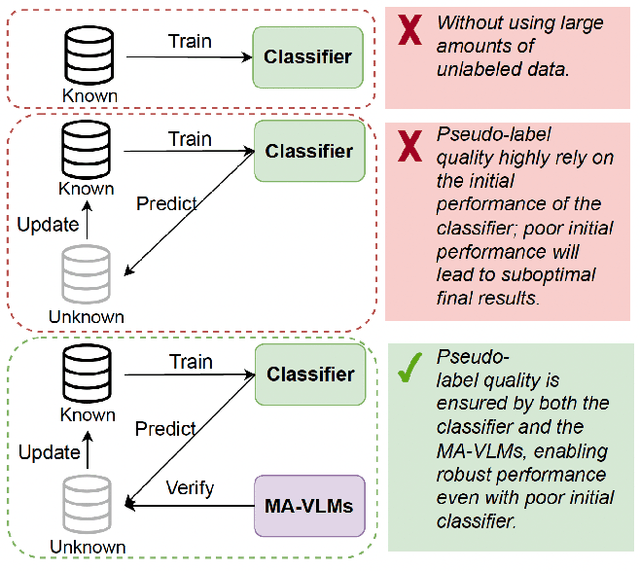
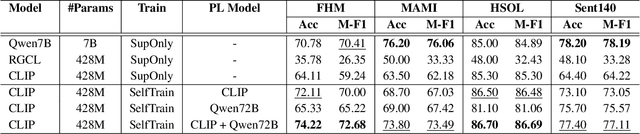
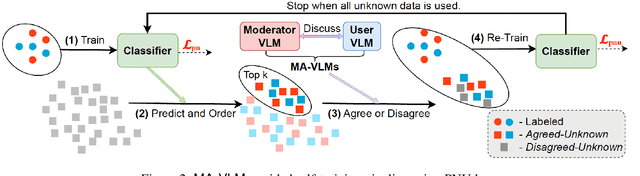

Accurate detection of offensive content on social media demands high-quality labeled data; however, such data is often scarce due to the low prevalence of offensive instances and the high cost of manual annotation. To address this low-resource challenge, we propose a self-training framework that leverages abundant unlabeled data through collaborative pseudo-labeling. Starting with a lightweight classifier trained on limited labeled data, our method iteratively assigns pseudo-labels to unlabeled instances with the support of Multi-Agent Vision-Language Models (MA-VLMs). Un-labeled data on which the classifier and MA-VLMs agree are designated as the Agreed-Unknown set, while conflicting samples form the Disagreed-Unknown set. To enhance label reliability, MA-VLMs simulate dual perspectives, moderator and user, capturing both regulatory and subjective viewpoints. The classifier is optimized using a novel Positive-Negative-Unlabeled (PNU) loss, which jointly exploits labeled, Agreed-Unknown, and Disagreed-Unknown data while mitigating pseudo-label noise. Experiments on benchmark datasets demonstrate that our framework substantially outperforms baselines under limited supervision and approaches the performance of large-scale models
SID: Multi-LLM Debate Driven by Self Signals
Oct 08, 2025Large Language Models (LLMs) have exhibited impressive capabilities across diverse application domains. Recent work has explored Multi-LLM Agent Debate (MAD) as a way to enhance performance by enabling multiple LLMs to discuss and refine responses iteratively. Nevertheless, existing MAD methods predominantly focus on utilizing external structures, such as debate graphs, using LLM-as-a-Judge, while neglecting the application of self signals, such as token logits and attention, that arise during generation. This omission leads to redundant computation and potential performance degradation. In this paper, we shift the focus to the self signals of multi-LLM debate and introduce a Self-Signals Driven Multi-LLM Debate (SID), which leverages two types of self-signals: model-level confidence and token-level semantic focus, to adaptively guide the debate process. Our approach enables high-confidence agents to exit early at the model level and compress the redundant debate contents based on the attention mechanism. We evaluate our method on various LLMs and Multimodal LLMs across multiple challenging benchmarks. Experimental results demonstrate that our method not only outperforms existing MAD techniques in accuracy but also reduces token consumption, highlighting the effectiveness of utilizing self signals in enhancing both the performance and efficiency of multi-agent debate systems. Our code will be available at~\href{https://github.com/xuhang2019/SID}{\texttt{https://github.com/xuhang2019/SID}}.
From Air to Wear: Personalized 3D Digital Fashion with AR/VR Immersive 3D Sketching
May 15, 2025In the era of immersive consumer electronics, such as AR/VR headsets and smart devices, people increasingly seek ways to express their identity through virtual fashion. However, existing 3D garment design tools remain inaccessible to everyday users due to steep technical barriers and limited data. In this work, we introduce a 3D sketch-driven 3D garment generation framework that empowers ordinary users - even those without design experience - to create high-quality digital clothing through simple 3D sketches in AR/VR environments. By combining a conditional diffusion model, a sketch encoder trained in a shared latent space, and an adaptive curriculum learning strategy, our system interprets imprecise, free-hand input and produces realistic, personalized garments. To address the scarcity of training data, we also introduce KO3DClothes, a new dataset of paired 3D garments and user-created sketches. Extensive experiments and user studies confirm that our method significantly outperforms existing baselines in both fidelity and usability, demonstrating its promise for democratized fashion design on next-generation consumer platforms.
POPEN: Preference-Based Optimization and Ensemble for LVLM-Based Reasoning Segmentation
Apr 01, 2025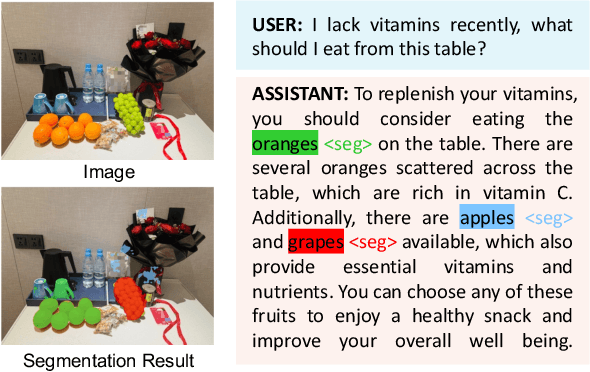
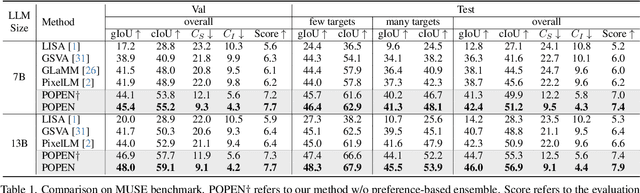
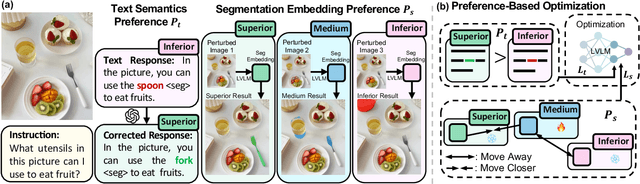
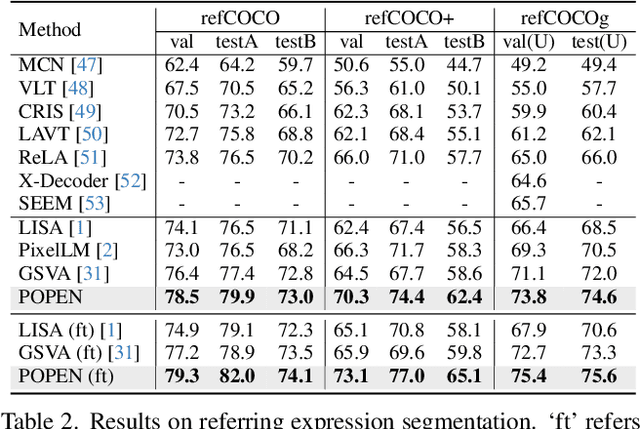
Existing LVLM-based reasoning segmentation methods often suffer from imprecise segmentation results and hallucinations in their text responses. This paper introduces POPEN, a novel framework designed to address these issues and achieve improved results. POPEN includes a preference-based optimization method to finetune the LVLM, aligning it more closely with human preferences and thereby generating better text responses and segmentation results. Additionally, POPEN introduces a preference-based ensemble method for inference, which integrates multiple outputs from the LVLM using a preference-score-based attention mechanism for refinement. To better adapt to the segmentation task, we incorporate several task-specific designs in our POPEN framework, including a new approach for collecting segmentation preference data with a curriculum learning mechanism, and a novel preference optimization loss to refine the segmentation capability of the LVLM. Experiments demonstrate that our method achieves state-of-the-art performance in reasoning segmentation, exhibiting minimal hallucination in text responses and the highest segmentation accuracy compared to previous advanced methods like LISA and PixelLM. Project page is https://lanyunzhu.site/POPEN/