 Add to Chrome
 Add to Firefox
 Add to Edge
$\mathcal{S}^2$IT: Stepwise Syntax Integration Tuning for Large Language Models in Aspect Sentiment Quad Prediction
Apr 25, 2026
Aspect Sentiment Quad Prediction (ASQP) has seen significant advancements, largely driven by the powerful semantic understanding and generative capabilities of large language models (LLMs). However, while syntactic structure information has been proven effective in previous extractive paradigms, it remains underutilized in the generative paradigm of LLMs due to their limited reasoning capabilities. In this paper, we propose S^2IT, a novel Stepwise Syntax Integration Tuning framework that progressively integrates syntactic structure knowledge into LLMs through a multi-step tuning process. The training process is divided into three steps. S^2IT decomposes the quadruple generation task into two stages: 1) Global Syntax-guided Extraction and 2) Local Syntax-guided Classification, integrating both global and local syntactic structure information. Finally, Fine-grained Structural Tuning enhances the model's understanding of syntactic structures through the prediction of element links and node classification. Experiments demonstrate that S^2IT significantly improves state-of-the-art performance across multiple datasets. Our implementation will be open-sourced at https://github.com/DMIRLAB-Group/S2IT.

S$^2$GSL: Incorporating Segment to Syntactic Enhanced Graph Structure Learning for Aspect-based Sentiment Analysis
Jun 07, 2024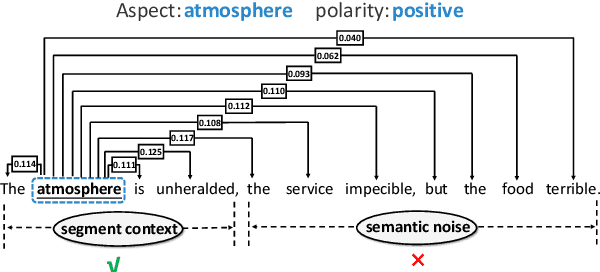
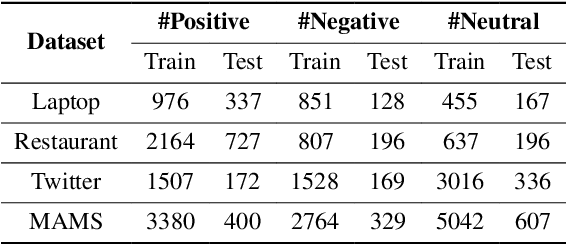
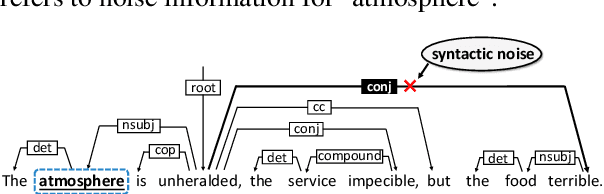
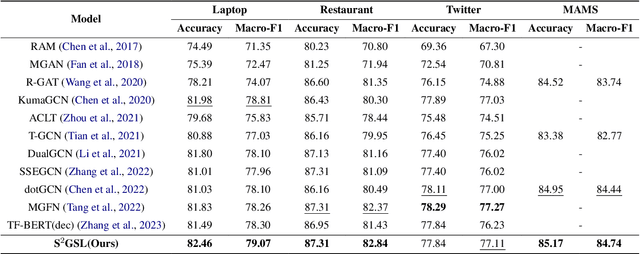
Previous graph-based approaches in Aspect based Sentiment Analysis(ABSA) have demonstrated impressive performance by utilizing graph neural networks and attention mechanisms to learn structures of static dependency trees and dynamic latent trees. However, incorporating both semantic and syntactic information simultaneously within complex global structures can introduce irrelevant contexts and syntactic dependencies during the process of graph structure learning, potentially resulting in inaccurate predictions. In order to address the issues above, we propose S$^2$GSL, incorporating Segment to Syntactic enhanced Graph Structure Learning for ABSA. Specifically,S$^2$GSL is featured with a segment-aware semantic graph learning and a syntax-based latent graph learning enabling the removal of irrelevant contexts and dependencies, respectively. We further propose a self-adaptive aggregation network that facilitates the fusion of two graph learning branches, thereby achieving complementarity across diverse structures. Experimental results on four benchmarks demonstrate the effectiveness of our framework.