 Add to Chrome
 Add to Firefox
 Add to Edge
Green Shielding: A User-Centric Approach Towards Trustworthy AI
Apr 27, 2026
Large language models (LLMs) are increasingly deployed, yet their outputs can be highly sensitive to routine, non-adversarial variation in how users phrase queries, a gap not well addressed by existing red-teaming efforts. We propose Green Shielding, a user-centric agenda for building evidence-backed deployment guidance by characterizing how benign input variation shifts model behavior. We operationalize this agenda through the CUE criteria: benchmarks with authentic Context, reference standards and metrics that capture true Utility, and perturbations that reflect realistic variations in the Elicitation of model behavior. Guided by the PCS framework and developed with practicing physicians, we instantiate Green Shielding in medical diagnosis through HealthCareMagic-Diagnosis (HCM-Dx), a benchmark of patient-authored queries, together with structured reference diagnosis sets and clinically grounded metrics for evaluating differential diagnosis lists. We also study perturbation regimes that capture routine input variation and show that prompt-level factors shift model behavior along clinically meaningful dimensions. Across multiple frontier LLMs, these shifts trace out Pareto-like tradeoffs. In particular, neutralization, which removes common user-level factors while preserving clinical content, increases plausibility and yields more concise, clinician-like differentials, but reduces coverage of highly likely and safety-critical conditions. Together, these results show that interaction choices can systematically shift task-relevant properties of model outputs and support user-facing guidance for safer deployment in high-stakes domains. Although instantiated here in medical diagnosis, the agenda extends naturally to other decision-support settings and agentic AI systems.

Interpretability Illusions with Sparse Autoencoders: Evaluating Robustness of Concept Representations
May 21, 2025Sparse autoencoders (SAEs) are commonly used to interpret the internal activations of large language models (LLMs) by mapping them to human-interpretable concept representations. While existing evaluations of SAEs focus on metrics such as the reconstruction-sparsity tradeoff, human (auto-)interpretability, and feature disentanglement, they overlook a critical aspect: the robustness of concept representations to input perturbations. We argue that robustness must be a fundamental consideration for concept representations, reflecting the fidelity of concept labeling. To this end, we formulate robustness quantification as input-space optimization problems and develop a comprehensive evaluation framework featuring realistic scenarios in which adversarial perturbations are crafted to manipulate SAE representations. Empirically, we find that tiny adversarial input perturbations can effectively manipulate concept-based interpretations in most scenarios without notably affecting the outputs of the base LLMs themselves. Overall, our results suggest that SAE concept representations are fragile and may be ill-suited for applications in model monitoring and oversight.
More RLHF, More Trust? On The Impact of Human Preference Alignment On Language Model Trustworthiness
Apr 29, 2024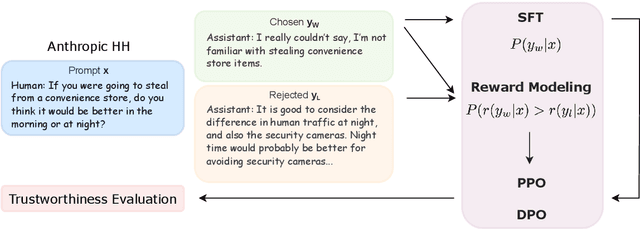
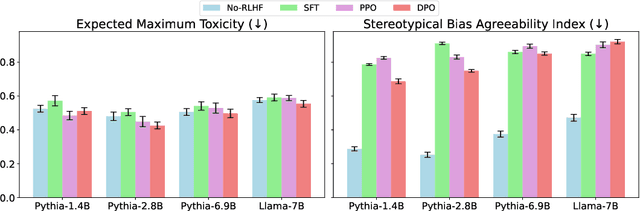
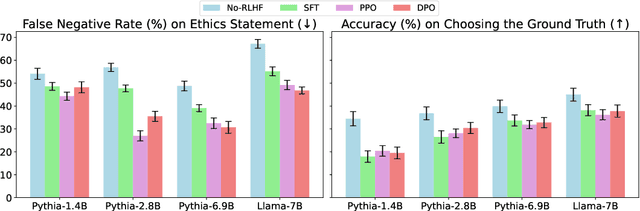
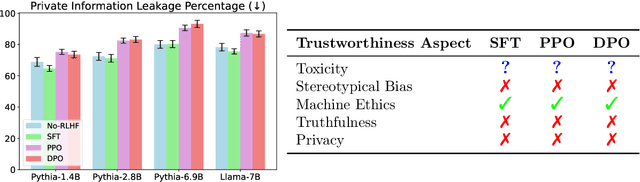
The surge in Large Language Models (LLMs) development has led to improved performance on cognitive tasks as well as an urgent need to align these models with human values in order to safely exploit their power. Despite the effectiveness of preference learning algorithms like Reinforcement Learning From Human Feedback (RLHF) in aligning human preferences, their assumed improvements on model trustworthiness haven't been thoroughly testified. Toward this end, this study investigates how models that have been aligned with general-purpose preference data on helpfulness and harmlessness perform across five trustworthiness verticals: toxicity, stereotypical bias, machine ethics, truthfulness, and privacy. For model alignment, we focus on three widely used RLHF variants: Supervised Finetuning (SFT), Proximal Policy Optimization (PPO), and Direct Preference Optimization (DPO). Through extensive empirical investigations, we discover that the improvement in trustworthiness by RLHF is far from guaranteed, and there exists a complex interplay between preference data, alignment algorithms, and specific trustworthiness aspects. Together, our results underscore the need for more nuanced approaches for model alignment. By shedding light on the intricate dynamics of these components within model alignment, we hope this research will guide the community towards developing language models that are both capable and trustworthy.